

The long winter nights give plenty of opportunity for stargazing.
Top constellations, prominent stars and two giant planets shine out in the night sky.
And there’s one of the best meteor displays of the year.
So here are our December skylights.
Stars and Planets
If you want to preview your night sky, I recommend Stellarium.
It’s a great piece of software that shows the night sky on any date and any location.
The free download is at Stellarium.
Looking North
We’ll begin by looking to the northern sky.
Keep the sunset on the left and north is directly in front.
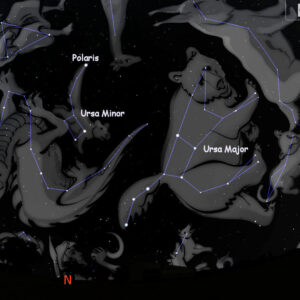
Northern sky: from Stellarium
The main constellations are the two bears.
Ursa Major, the Great Bear, dominates the northern sky.
To the left is Ursa Minor, the Little Bear.
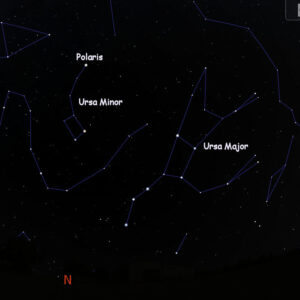
Stellarium shows the outline of both star patterns.
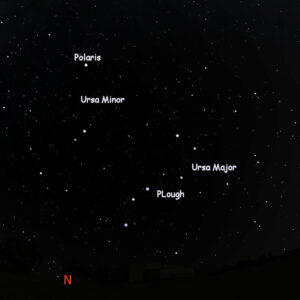
The seven bright stars of Ursa Major make up the Plough or Big Dipper.
The upper two stars of the Plough point to Polaris, the North Star or Pole star.
Polaris is the tail of the Little Bear.
Here’s a challenge: can you see the whole outline of the Great Bear in your sky?
The Pole Star is almost directly above the North Pole of Earth.
As Earth spins on its axis each day, the stars appear to move.
All except Polaris. Above our North Pole, the Pole star remains almost fixed in the night sky.
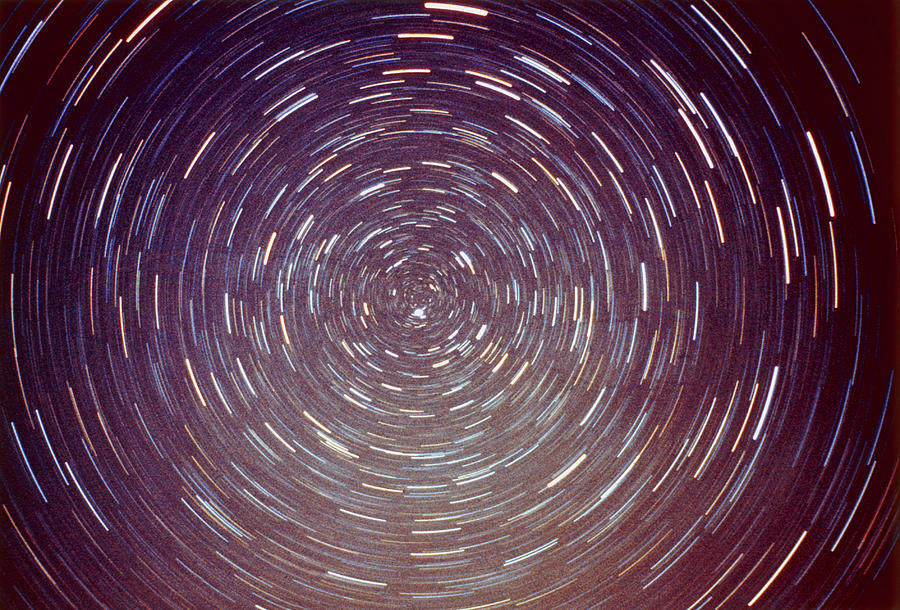
Star trails around Polaris. Credit: US Naval Observatory
You can always find which direction is north by locating Polaris.
In the past, sailors found the North Star important for navigation at night.
To be honest, north is the least interesting direction for stargazing.
So let’s turn our back on Polaris and look to the southern sky.
Looking south west
The autumn stars are steadily sinking toward the horizon.
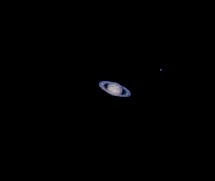
And so is Saturn.
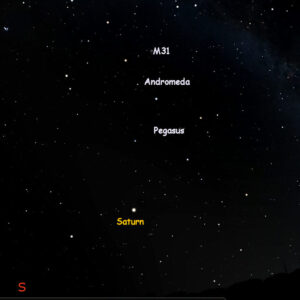
The second-largest planet is low in the southwest sky, brighter than the stars there.
A small telescope will resolve the wonderful rings.
Above Saturn, the Square of Pegasus is tilting to become a diamond shape.
Above left of the square are the stars of Andromeda.
Try this. From and including the top left star of the square, count three stars upwards.
Then go three dimmer stars to the right.
You may see there a small, hazy glow of light.
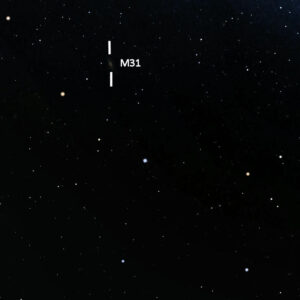
That glow comes from the furthest object you can see with the naked eye.
It is light from the centre of the Andromeda Galaxy.
The galaxy is 2.5 million light years away.
The light that enters your eye left the galaxy two-and-a -half million years ago!
Looking southeast
As stars set in the west, others are rising in the east.
These are the best stars and constellations of the year.
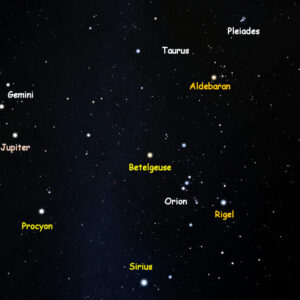
The great star sign of Orion can be found by the three stars lined up in his belt.
To the lower right is superstar Rigel, 60,000 times brighter than our Sun.
At the upper left is supergiant Betelgeuse, almost a thousand time wider than the Sun.
Orion’s three-star belt points up to Aldebaran, red eye of Taurus the Bull.
That upward line leads to the lovely star cluster, the Pleiades or Seven Sisters.
How many sisters can you see in your sky?
Pleaides: NASA / HST
Orion’s belt points down to Sirius, brightest star in our night sky.
That brightness is due to the closeness of Sirius.
It is only 9 light years away.
Above Sirius is Procyon.
Draw a line from Procyon to Betelgeuse and then Sirius and you have made the Winter Triangle.
Finally look above Procyon to the two twin stars of Gemini.
But before you get there, you’ll see an intruder.
Just below the twins lies Jupiter, king of the planets.
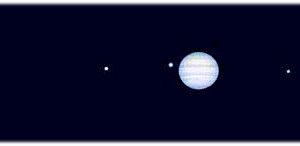
Jupiter and moons
That’s a superb night sky. And there’s more!
December brings a great display of shooting stars.
The Geminid Meteors
The Geminid meteors are active from December 4th to 20th.
The peak night is December 13th to 14th.
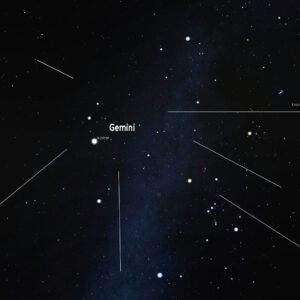
Geminid meteor tracks: Stellarium
The shooting stars scatter across the sky from a point in the constellation Gemini.
They can be seen all through the night.
The peak hours are from 2am to 3am.
At the peak, over 100 meteors per hour may be seen in perfect conditions.
In a city, light pollution reduces the number to a few tens.
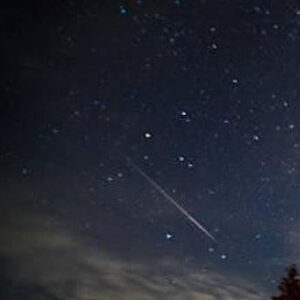
Each shooting star is caused by a particle only as big as a grain of sand.
They enter the atmosphere travelling at over 30 km per second.
Each particle ionises the air, forming a glowing tube of gas.
This glowing, growing air tube looks like a falling star.
Geminid meteors are often yellow in colour.
The particles come from an asteroid called Phaethon.
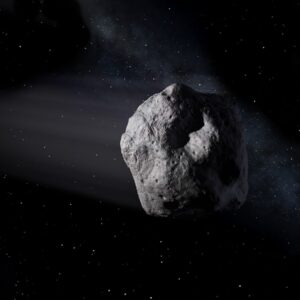
Asteroid Phaethon. NASA
This is unusual, because most meteor particles come from comets.
Phaethon may be the remains of a comet whose ice has disappeared over time.
So, for the Geminids: remember, remember the 13th of December!
Coming next
I hope that you’ve enjoyed our Wonderdome blogs in 2025.
Our final blog of the year is a Christmas quiz.
It combines literature, sport and popular culture with astronomy.
It will be online on December 15th.

The author: Dennis Ashton, MBE, is a Fellow of the Royal Astronomical Society and a Wonderdome presenter.
In 2024, Dennis received the Special Contribution award from the British Association of Planetaria.
In 2025 he became a Member of the Order of the British Empire for over 50 years work in Astronomy Education.
WonderDome: Leading the Way in Mobile Planetariums
WonderDome offers a fully immersive experience, taking you on a journey through the cosmos. Perfect for all ages and abilities. We now boast a team of 15 presenters, located all over the UK, establishing us as the largest – and best – mobile planetarium organisation in the UK.
Stay Connected for Astronomy News and Events Follow WonderDome mobile planetarium on Twitter / X, Facebook, Instagram and TikTok to stay up to date on the latest news, shows and offers. Or visit our website at wonderdome.co.uk. WonderDome is part of the Service4Education Group