

In our January blogs, we focussed on the big space event of the year
Artemis 2 is due to take astronauts around the Moon.
Now we’ll take a look at other space missions planned for 2026.
It’s a year which will see both international rivalry and cooperation.
I’ve selected robotic missions that will add to our understanding of the universe.

So get ready for a year of new missions and new acronyms.
And who will win the BATY award, the Best Acronym of The Year?
We’ll begin with three new space telescopes.
Together with the ground-based Vera Rubin telescope, they will tackle big mysteries of the universe.
PLATO
I’ll begin with a BATY contender.
PLATO is a European Space Agency (ESA) space telescope.
Its aim is to find small rocky planets in orbit round distant stars.
It’s a step on the road to find evidence of alien life.
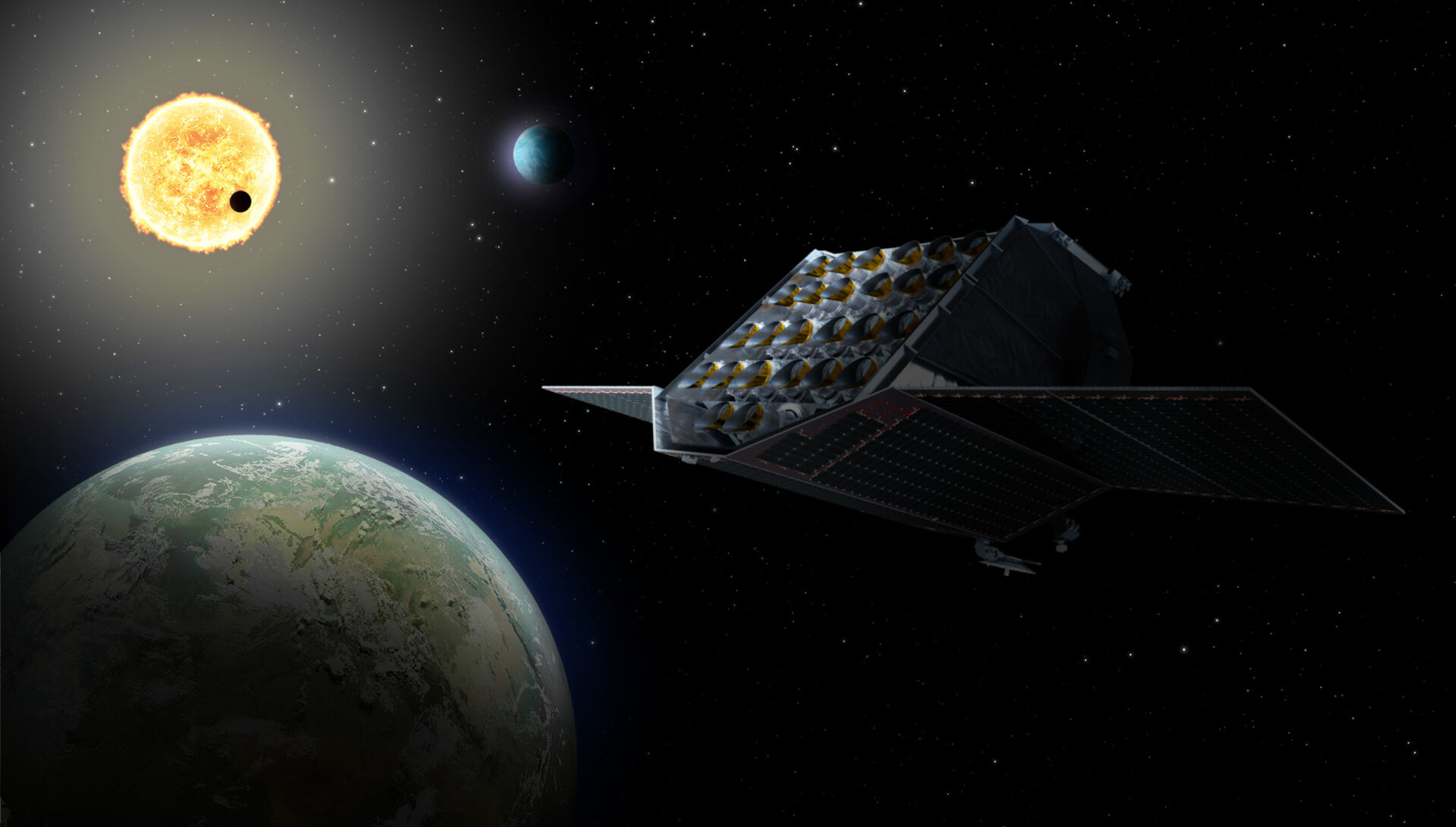
PLATO space telescope: ESA
PLATO will discover exoplanets as they cross in front of their star.
That’s called a transit. It will look at over one million stars.
It will also detect star oscillation, seismic activity.
So what does PLATO stand for?
It’s PLAnetary Transits and Oscillations of stars.
PLATO is scheduled for launch in December this year.
And, of course, Plato was a Greek philosopher from the 4th century BC.
Roman Space Telescope
For a change, the Roman space telescope is not an acronym.
It is named for Nancy Grace Roman, former head of NASA’s Chief of Astronomy.
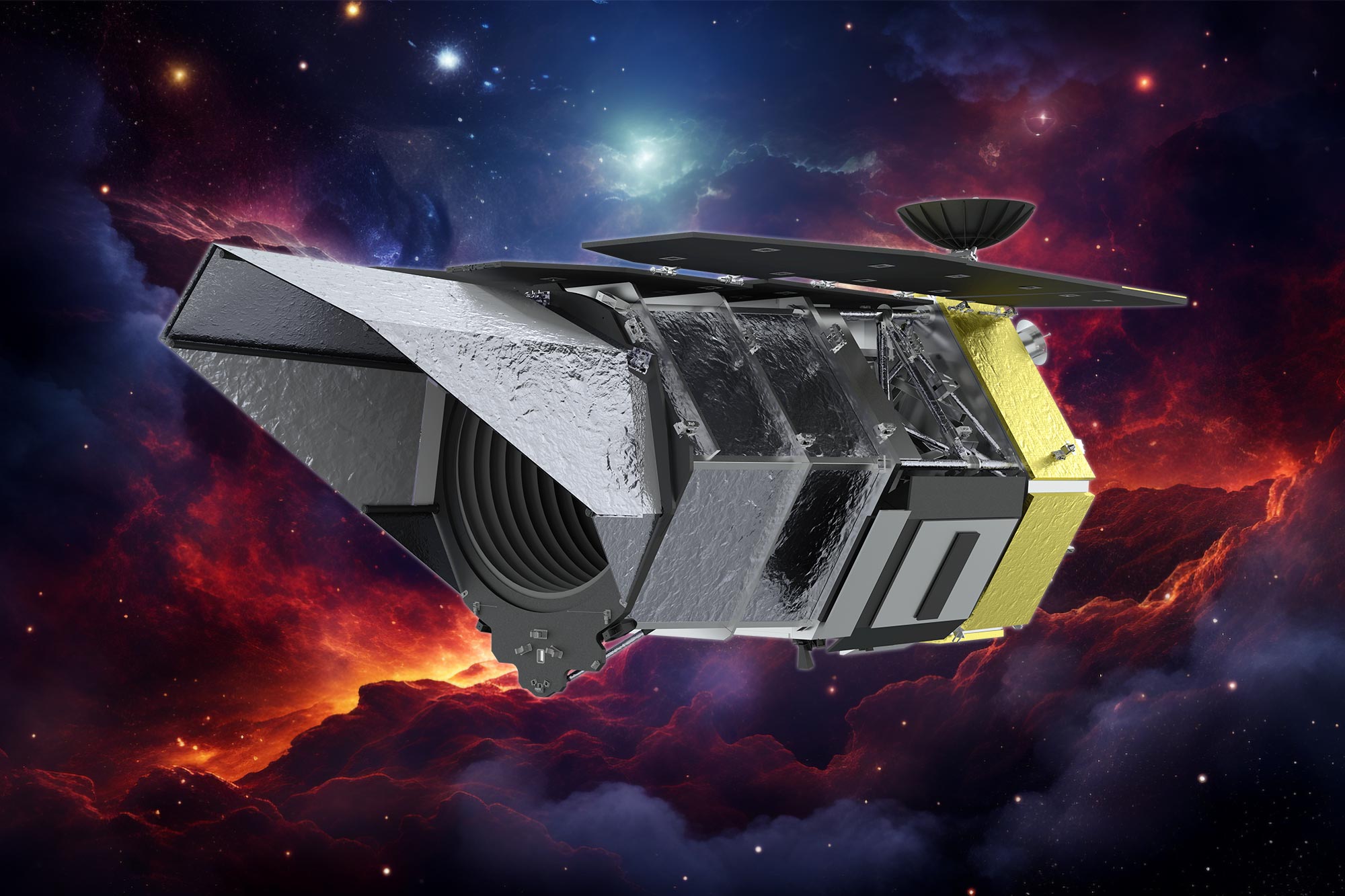
Roman Space Telescope: NASA
This new space telescope will be able to view an area 100 times greater than Hubble.
It will map millions of distant galaxies and help understand Dark Matter and Dark Energy.
For me, the most exciting project will be to directly image exoplanets in orbit around distant stars.
This will pave the way for future telescopes to search for alien life.
Roman is due for launch in autumn.
Xuntian Space Telescope
China will join the 2026 space telescope bonanza with Xuntian.
Like Roman, Xuntian will observe distant galaxies and the structure of the universe.
It will have a field of view 300 times larger than Hubble but with equal clarity.
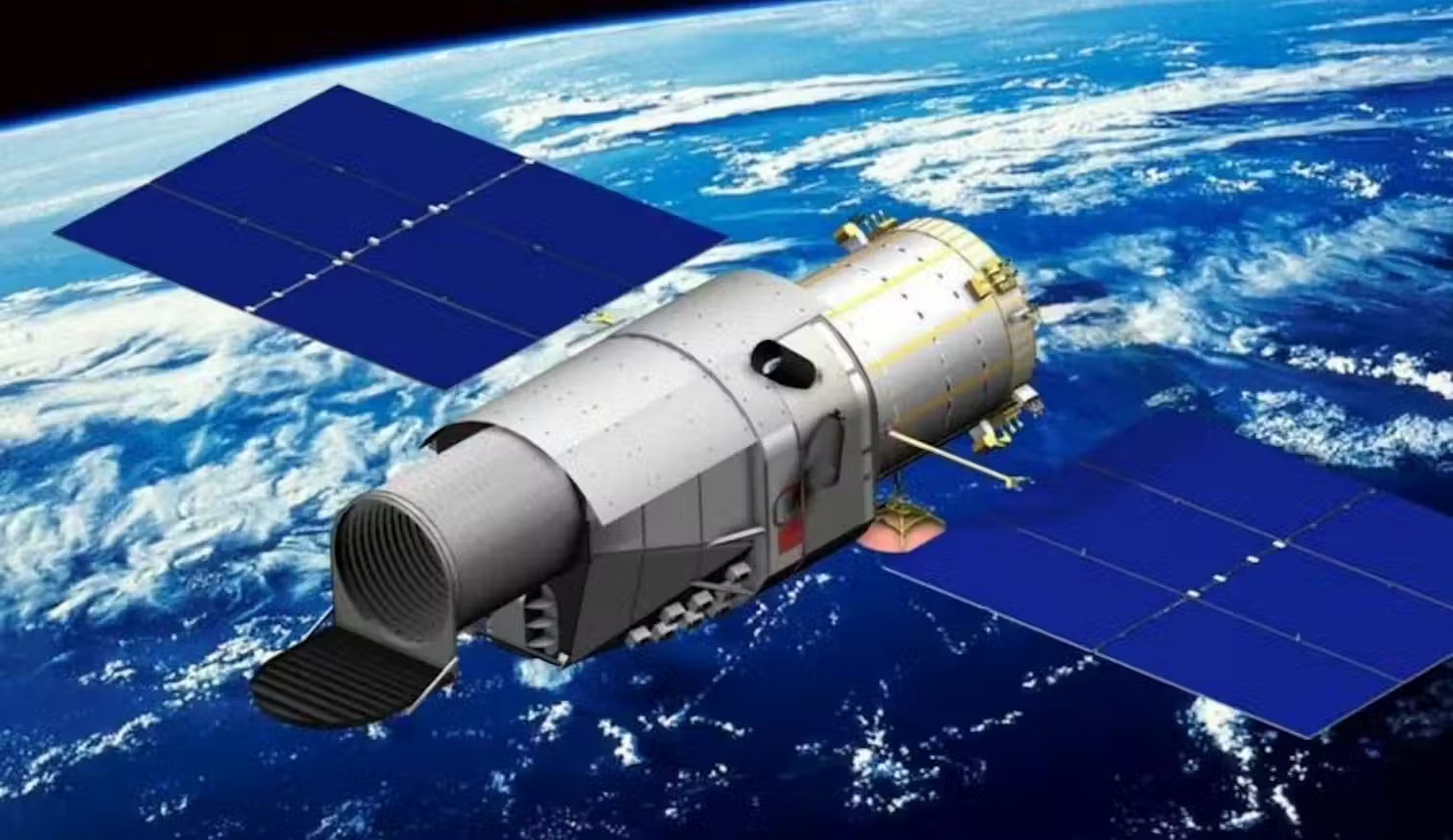
Xuntian Space Telescope: China National Space Administration
Xuntian will be unique in orbiting alongside Tiangong, China’s space station.
This will allow astronauts to maintain and service the telescope.
Chang’e 7
Closer to home, China’s Chang’e 7 mission will explore the Moon.
In particular it will observe the lunar south pole.
This area may hold ice, a source of water and energy for future astronauts.
It is also the landing area for NASA’s Artemis 3 manned landing.

Chang’e 7 will orbit the Moon. It will also take a robotic lander and rover.
The mission should launch in the summer.
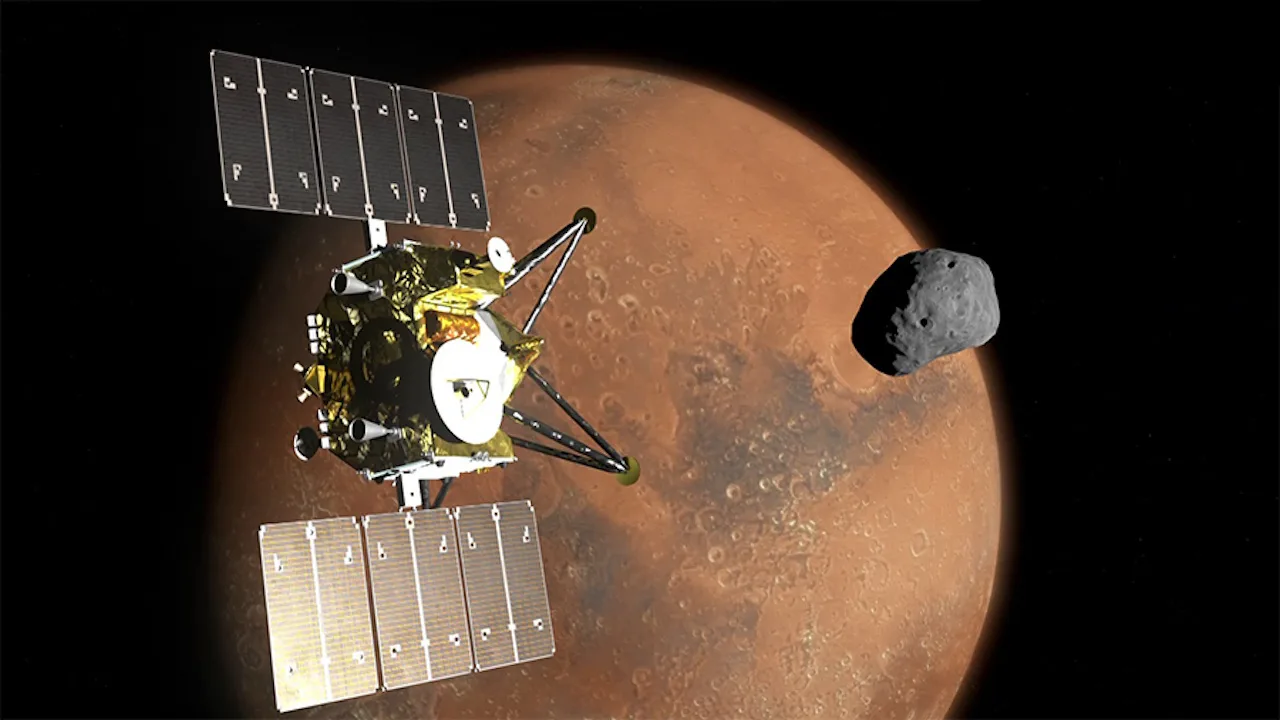
MMX
Meanwhile, Japan intends to explore the moons of Mars.
And with an acronym in English!
Their Martian Moons eXploration spacecraft will spend three years looking at Phobos and Deimos.

A lander will collect samples from the surface of Phobos and return them to Earth in 2031.
It may solve the puzzle of the origins of these tiny Martian moons.
Are they captured asteroids or did they form alongside the red planet?
In a refreshing piece of international co-operation, MMX will carry instruments from both NASA and ESA.
SMILE
International partnership should raise a smile, or in this case SMILE.
The Solar wind Magnetospher Ionosphere Link Explorer is a collaboration between China and Europe.
SMILE will study how the solar wind – particles blasted out by the Sun – affects our Earth.

SMILE in flight configuration: ESA–B.Vanoutryve
Recently we have had wonderful aurorae from an active Sun.
They result from a storm of particles hitting our atmosphere.
But such storms can cause disruption to life on Earth.
The electromagnetic blast can knock out satellites, navigational aids and power grids.

SMILE will give us greater knowledge about the effects of solar storms on Earth.
We might learn how better to protect the world’s electronic structures.
It may also help us to protect astronauts on future missions to distant worlds.
In these times of international tensions, it’s good to see cooperation in space.
Both China and Europe will gain by working together.
And SMILE wins my BATY award, the Best Acronym of the Year!
Ongoing Missions
Finally I’ve picked out two robotic missions which are already in space.
Both will reach a major landmark in their exploration of the Solar System.
BepiColumbo
This project is another demonstration of international cooperation.
BepiColumbo is a joint project between the European Space Agency, ESA and it’s Japanese counterpart, JAXA.
It has two orbiters, one from each agency.
In November this year, BepiColumbo will enter orbit round Mercury.
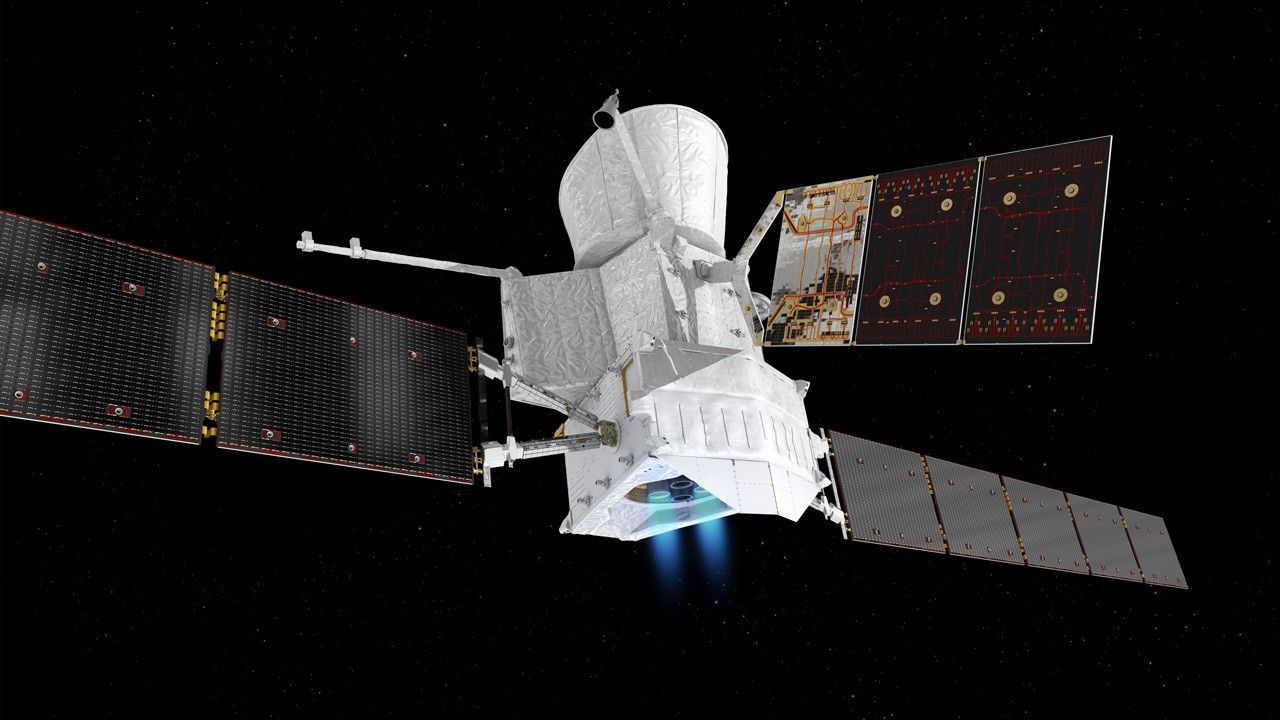
BepiColumbo spacecraft: ESA / JAXA
The craft has been in space since 2018.
Since then it has carried out flyby loops of both Venus and Mercury.
This year sees its primary objective: a detailed study of planet Mercury.
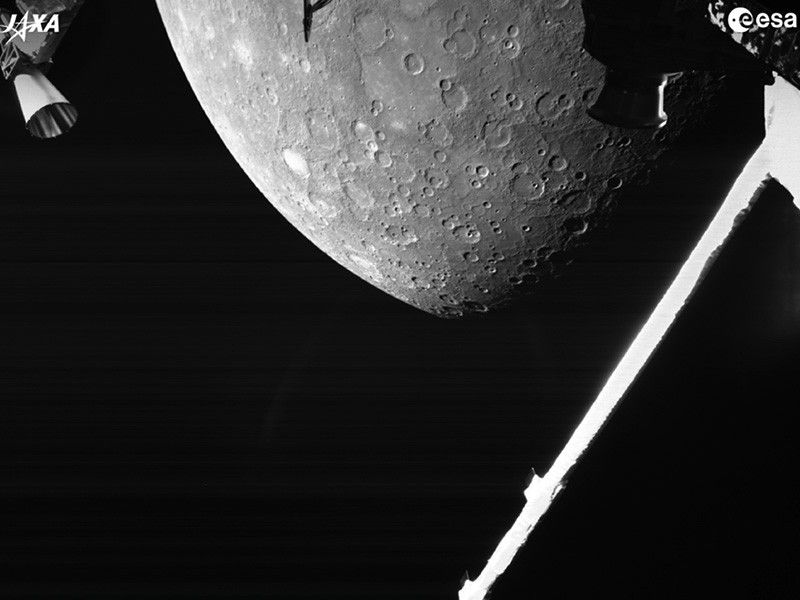
Mercury seen from BepiColumbo on a flyby: ASE / JAXA
And the name? Not an acronym this time.
Giuseppe ‘Bepi’ Columbo (1920 – 1984) was an Italian scientist.
He proposed the gravity assist trajectory for interplanetary flight.
This technique has been used for many missions, including this one.
Hera
Let’s finish with a plethora of acronyms.
Hera is an ESA (European Space Agency) mission to visit near-Earth asteroids.
It’s part of the Asteroid Impact and Deflection Assessment (AIDA) programme.
The aim is to protect Earth from a devastating collision with an asteroid.
Hera will visit the double asteroid Didymos.
It will arrive in November this year.

Hera at Didymos, artist impression: ESA
Didymos was impacted by NASA’s DART spacecraft in 2022, the Double Asteroid Redirection Test.
Hera will assess the effects of the DART collision.
It will also launch two small satellites to study the asteroid pairing.
Hera is the first mission on ESA’s planetary defence programme.
Surprisigly perhaps, Hera’s name is not an acronym.
Hera was the Greek goddess of marriage, appropriate for a visit to an asteroid pair.
Another year in space
2026 promises to be another vintage year for space exploration.
Space telescopes will further enhance our view of the universe.
Robotic space probes will continue to explore the Solar System.
And Artemis 2 is another step on our return to the Moon.
Space 2026 is go for lift-off!

The author: Dennis Ashton, MBE, is a Fellow of the Royal Astronomical Society and a Wonderdome presenter.
In 2024, Dennis received the Special Contribution award from the British Association of Planetaria.
In 2025 he became a Member of the Order of the British Empire for over 50 years work in Astronomy Education.
WonderDome: Leading the Way in Mobile Planetariums
WonderDome offers a fully immersive experience, taking you on a journey through the cosmos.
Perfect for all ages and abilities.
We now boast a team of 15 presenters, located all over the UK, establishing us as the largest – and best – mobile planetarium organisation in the UK.
Stay Connected for Astronomy News and Events Follow WonderDome mobile planetarium on Twitter / X, Facebook, Instagram and TikTok to stay up to date on the latest news, shows and offers. Or visit our website at wonderdome.co.uk. WonderDome is part of the Service4Education Group