

In our Wonderdome shows, presenters are sometimes asked ‘which is the biggest star’.
And sometimes a youngster tells us which is the biggest star.
It’s time to revisit the topic and reveal the name of the biggest star.
Star Size
By their nature, stars are big.
They must be massive enough to sustain the nuclear reactions that makes them shine.
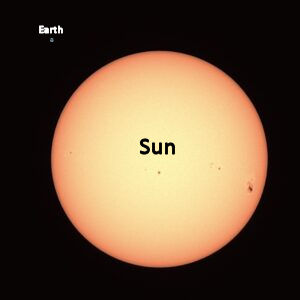
The Sun is a fairly ordinary star.
Yet 109 Earths would fit across its diameter.
Over one million Earths could fit inside it!
Let’s define what we mean by star size.
We’ll measure it by diameter – how wide the star is, measured in miles or kilometres.
We might also refer to its volume: for example, how many Suns could fit inside it.
We’ll also refer to a star’s mass. That’s how much stuff it’s made of, how much gas it contains.
Main Sequence stars
These are hydrogen burning stars.
They are ‘normal’ stars, stars in the prime of their long lives.
The Sun is a Main Sequence star.
It’s about halfway through it’s 10 billion year life span.
Sun size
Our Sun is about 1.4 million kilometers across.
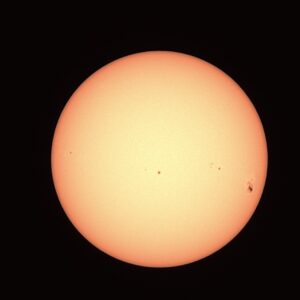
Sun: D. Ashton
That’s a huge diameter in Earth terms but not big for a star.
We’ll use the Sun as a reference point for other stars.
Red Dwarf Stars
As their name implies, these are small stars.
The are low mass, made of relatively low amounts of gas.
They are still on the Main Sequence, ‘normal stars’, but burn their hydrogen slowly.
They are so dim that they are hard to see, even with very large telescopes.
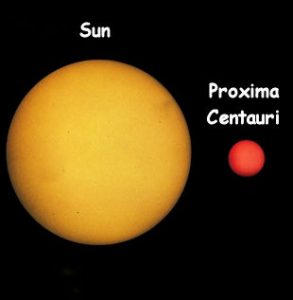
Proxima Centauri & Sun: D. Ashton
An example is Proxima Centari, the nearest star to us.
It is only 200,000 km across.
That’s about one-seventh the size of the Sun.
So red dwarfs are at the bottom end of the size scale.
Medium-mass stars
There are many stars like the Sun but bigger.
They contain more mass, more gas, than the Sun.
They weigh in at 1.5 to 3 times the mass of the Sun.
An example is Sirius A, the brightest star in our night sky.
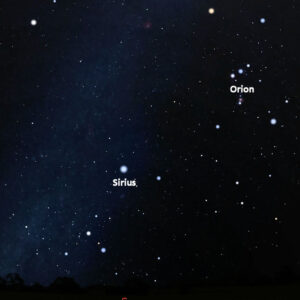
Sirius: Stellarium
Actually it’s the brightest because it’s close, only 9 light years away.
It’s diameter is 2.4 million km, almost twice the size of the Sun.
High Mass Stars
High mass stars are made of an enormous amounts of gas.
They can weigh in at 8 times to over 100 times the mass of the Sun.
An example is Bellatrix, the bright star at the upper right of Orion.
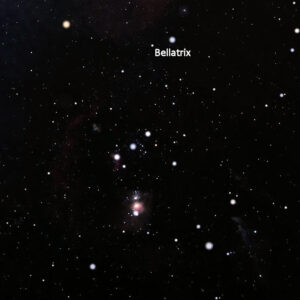
Orion: Stellarium
Bellatrix is 8 times the mass of our Sun and shines over 6,000 times brighter.
It’s around 6 times wider than the Sun, with a diameter of 9 million kilometres.
This doesn’t make Bellatrix a contender for the biggest star – yet.
But in the future that will change.
Red Giants
The stars so far have been hydrogen- burning, normal stars.
When stars reach the end of their lives, when they have used up their hydrogen, they grow in size.
Dying stars become red giants.
Aldebaran
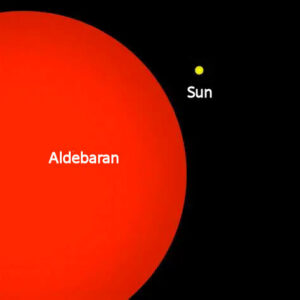
A nice example of a red giant is Aldebaran, the red eye of Taurus the Bull.
This was once a star much like our Sun.
Now it is dying. It has swollen up to become 45 times wider than the Sun.
Its diameter is about 63 million km.
Red Supergiants
Although red giants are big, they are not the biggest stars.
When high-mass stars finally die, they grow to become red supergiants.
These stars are 8 to 100 times the mass of our Sun.
They can be hundreds of times wider.

Earlier, we mentioned Bellatrix in Orion.
When that star dies, it will become a supergiant.
Betelgeuse
Betelgeuse lies at the top left of Orion.
This superstar contains about 20 times the mass of the Sun but it’s huge, over 760 times wider than the Sun.
It’s diameter is a colossal 1,000 million km!
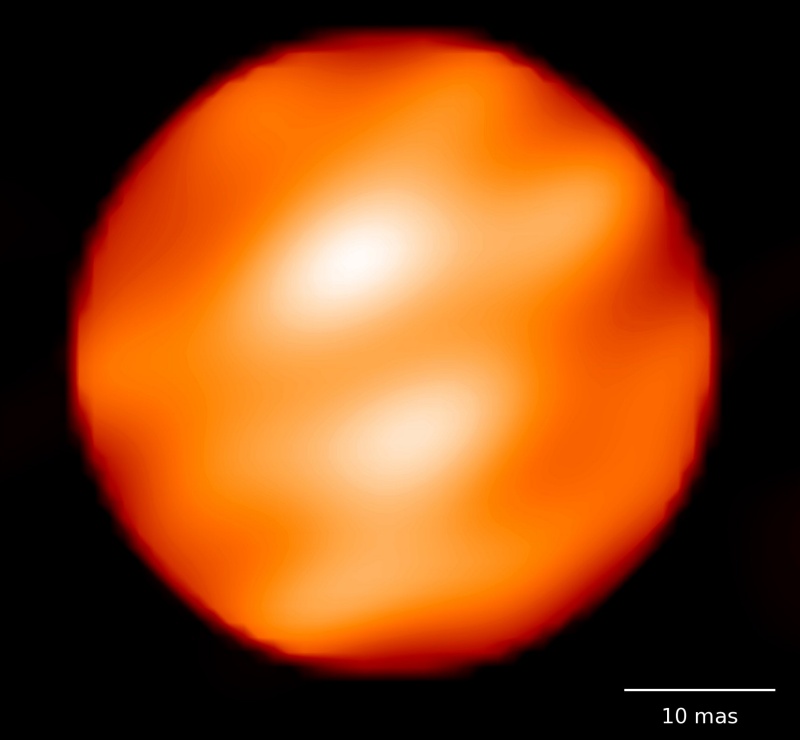
Betelgeuse: Xavier Haubois, Observatoire de Paris
If Betelgeuse replaced our Sun, we would be inside it.
It would stretch out beyond Mars to the asteroid belt.
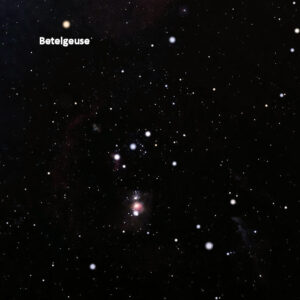
Orion: Stellarium
Betelgeuse is now burning heavier nuclear fuels in its core.
Fusion reactions creat carbon, nitrogen, oxygen, silicon and all the elements up to iron.
When the iron core becomes too big, the star explodes a supernova.
The remains of the star are crushed by gravity to become a neutron star or black hole.
Hypergiant Stars
Now we come to the top of the league in star size.
These are sometimes called hypergiants.
And there will be some controversy as we identify THE biggest star.
Measuring the size of stars is not a precise science.
It depends on knowing the distance and true brightness of stars.
Neither is a precise measurement, more an estimation.
The league table changes as new observations are made.
So here’s my top 5 biggest stars.
Mu Cephei
This is perhaps the biggest star visible to the naked eye.
It’s called the Garnet Star because of its deep red colour.
It lies 3,000 light years away in the constellation Cepheus.

Mu Cephei: APOD, NASA
Mu Cephei is around 1,200 times wider than the Sun.
Like Betelgeuse, its destiny is to explode and leave a black hole.
VY Canis Majoris
This red hypergiant is 3,900 light years away in Canis Major, the Big Dog.
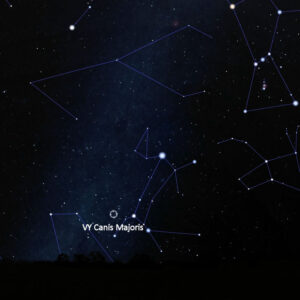
Position of VY Canis Majoris: Stellarium
It is 1,400 times wider than the Sun, a diameter of 2 billion km.
VY Canis Majoris is surrounded by masses of gas and dust expelled in the star’s death throes.
For a while, it was the biggest known star.
Now others have overtaken it. We’re at my top three.
Yes, I have three contenders for the number one biggest star.
Stephenson 2-18
This star is often quoted as the largest known star.
It may well be but it’s true size is riddled with uncertainty.
Stephenson 2-18 lies in the direction of a cluster of stars 20,000 light years away.
There are problems measuring its distance.
It might be part of the distant cluster or it may be in front of it.
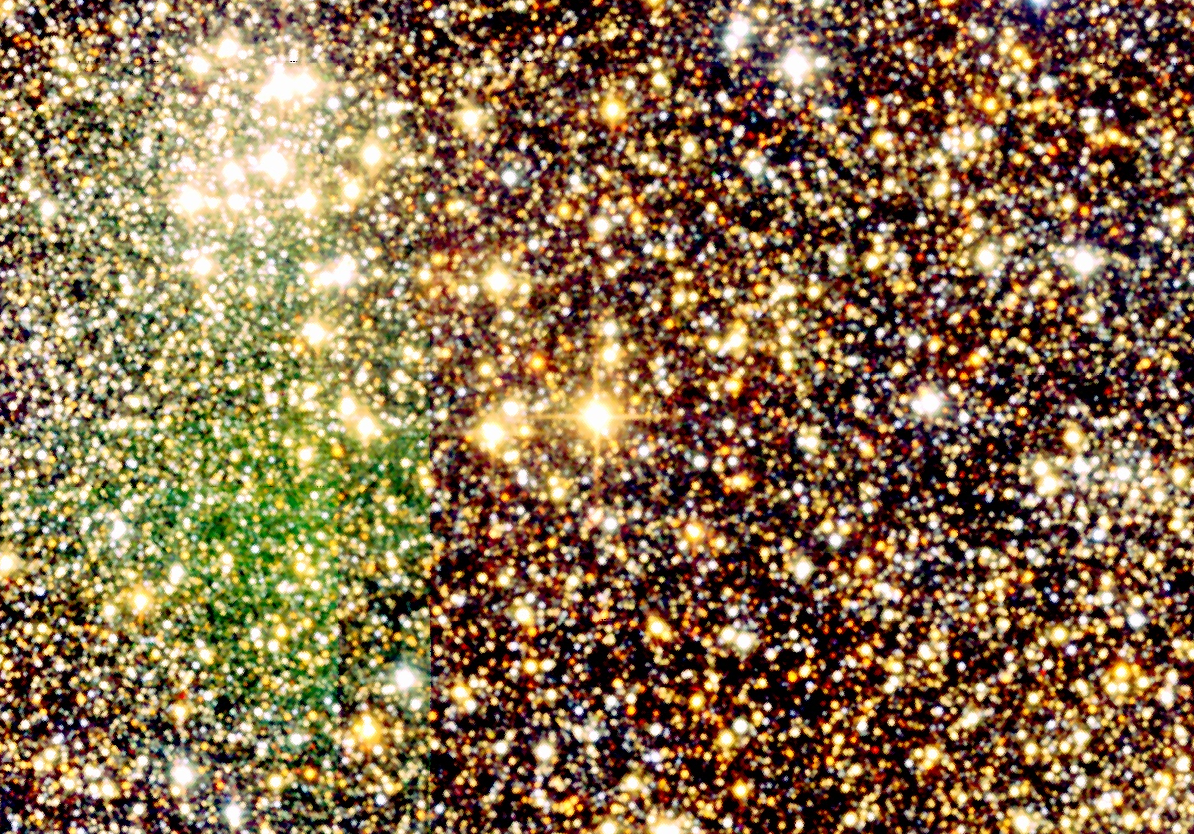
Stephenson Cluster and 2-18: 2MASS Survey
If it is part of the cluster, it is the biggest star.
The figures would be amazing.
Diameter- 3 billion km, 2,150 times wider than the Sun.
Place it where the Sun is and it would stretch out beyond the orbit of Saturn.
And 10,000,000,000 Suns would fit inside it!
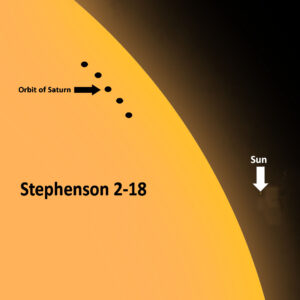
However the uncertainty about its distance casts doubt on it’s number one status.
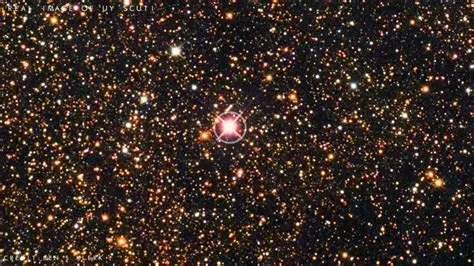
UY Scuti
So we’ll turn to a star with more precise data. It’s UY Scuti.
The star lies 9,500 light years away in the constellation Scutum.
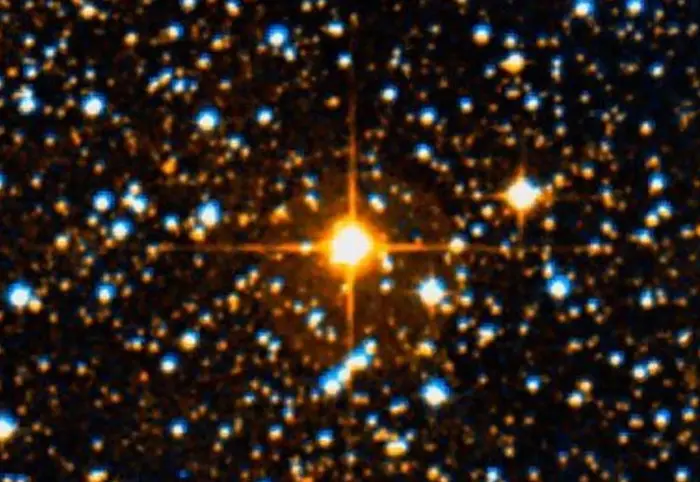
UY Scuti: 2MASS Survey
It is 1,700 times wider than our Sun, a diameter of 2,400,000,000 km!
Put it in place of the Sun and its surface would be close to the orbit of Saturn.
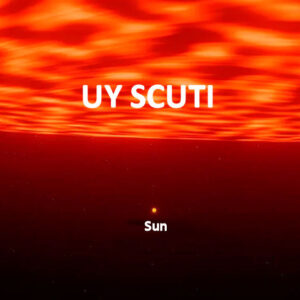
It’s so big, over 7 billion Suns could fit inside it!
When UY Scuti goes supernova, it will light up our galaxy.
UY Scuti is certainly a contender for the largest star.
R136a1
UY Scuti or Stephenson 2-18 are arguably the largest stars in terms of physical size, diameter and volume.
But there is another contender for biggest known star, not in size but in mass.
In simple terms, R136a1 is the heaviest star known.
And its statistics reveal it as a true superstar.
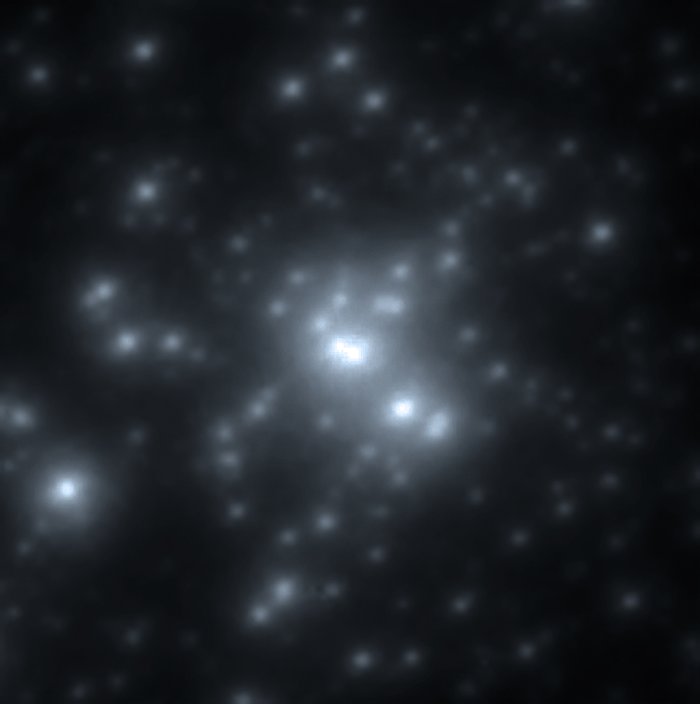
R136a is at the centre of this infrared image by ESO/P. Crowther/C.J. Evans
Although only 30 times wider than our Sun, it weighs in at 315 times the Sun’s mass.
That’s remarkable but it’s brightness is staggering.
The Sun’s surface temperature is 5,800 degrees.
The surface of R136a1 is 46,000 degrees.
As a result, R136a1 shines over 8 million times brighter than our Sun!
It is one of the most luminous stars known.
R136a1 is a blue superstar, known as a Wolf-Rayet star.
Unlike the red supergiants, it is not dying.
It’s burning up its hydrogen at a tremendous rate to give that amazing brightness.
Large Megallanic Cloud: NASA / HST
R136a1 is not in our galaxy. It is in the Large Megallanic Cloud, a small irregular galaxy some 163,000 light years away.
And that terrible name? The star is object number 136 in the Radcliffe catalogue of stars in the Large Megallanic Cloud.
The largest star(s)
So there we are, three number one contenders for the title of the largest star known.
Stephenson 2-18 or UY Scuti is the largest in size, take your pick. R136a1 is the largest in mass.
This ramble through the sizes of stars has again revealed what an amazing universe we live in.
These huge balls of gas are true giants of space.
Next time we’ll look at the other end of the size scale.
We’ll explore the fascinating topic of the smallest stars.

The author: Dennis Ashton, MBE, is a Fellow of the Royal Astronomical Society and a Wonderdome presenter.
In 2024, Dennis received the Special Contribution award from the British Association of Planetaria.
In 2025 he became a Member of the Order of the British Empire for over 50 years work in Astronomy Education.
WonderDome: Leading the Way in Mobile Planetariums
WonderDome offers a fully immersive experience, taking you on a journey through the cosmos. Perfect for all ages and abilities. We now boast a team of 15 presenters, located all over the UK, establishing us as the largest – and best – mobile planetarium organisation in the UK.
Stay Connected for Astronomy News and Events Follow WonderDome mobile planetarium on Twitter / X, Facebook, Instagram and TikTok to stay up to date on the latest news, shows and offers. Or visit our website at wonderdome.co.uk. WonderDome is part of the Service4Education Group