

In a recent blog, I looked at the biggest stars in the Universe.
Now we’ll explore the other end of the cosmic scale.
It’s time to look at the smallest stars.
We’ll reveal the smallest star in our galaxy.
Red dwarfs
Red dwarf stars are much smaller than our Sun.
They are the smallest and coolest stars on the Main Sequence of hydrogen-burning stars.
Their diameters range from 10% to 50% the size of our Sun.
That’s around 100,000 km to 700,000 km wide.
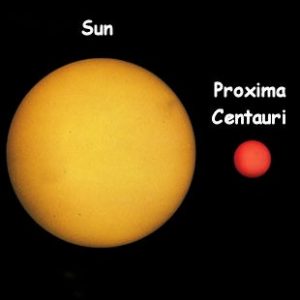
Sun and Proxima Centauri: D Ashton
The closest star to our Sun is a red dwarf.
Proxima Centauri is part of a three-star system about 4.25 light years away.
Red Dwarfs shine feebly in space, invisible to all but the largest telescopes.
They burn up their hydrogen fuel slowly.
This means they are the longest living stars.
They will exist for billions, even trillions, of years.
Red Dwarfs will be the last stars to shine as the Universe grows old.
The smallest known red dwarf star is OGLE-TR-122b.
It orbits a Sun-size star in the constellation Carina.
OGLE-TR-122b is only 167,000 km across. That’s only 20% larger than Jupiter.
However OGLE-TR-122b has 100 times the mass of Jupiter.
And that name? It comes from its discovery by the Optical Gravitational Lensing Experiment.

OGLE-TR-122b compared to the planets. Credit: Paul Stansifer, NASA, Celestia, JPL/Caltech
So that’s the smallest star measured up to now.
But there are smaller star-like objects.
They are failed stars or dead stars, stellar corpses.
Brown Dwarfs
Brown dwarfs are enigmatic objects.
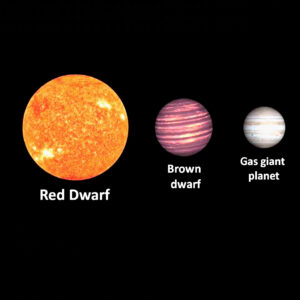
In size they lie between gas giant planets and red dwarf stars.
Sometimes they are called ‘failed stars’.
Brown Dwarfs weigh in at 10 to 80 times the mass of Jupiter.
Like normal stars, they form from the collapse of a hydrogen gas cloud.
But they contain too little gas to sustain the fusion of hydrogen atoms.
They shine feebly as a result of heating in the gravitional collapse.
Brown dwarfs are almost invisible but reveal their presence in infra-red radiation – their heat.
White Dwarfs
White dwarfs are dead stars.
When a star dies, it blows most of its gas into space.
The result is an expanding gas cloud known as a planetary nebula.
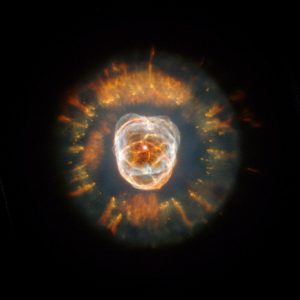
Eskimo Nebula: NASA / HST
What remains of the star is its core, its centre.
This is where hydrogen atoms fused to make helium and heavier elements.
As the star dies, it’s core is crushed by gravity to make a white dwarf.
In the image of the Eskimo planetary nebula, the white dwarf is at the centre.
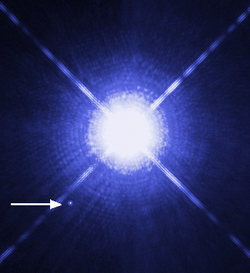
Sirius a & b: NASA / HST
The nearest white dwarf is held by the Dog Star, Sirius.
The bright main star, Sirius a, has a companion, shown by the arrow.
This is the remains of a star which made a double star with Sirius a.
The companion star died and its white dwarf remnant remains close.
White dwarfs are dense.
They can weigh as much as the Sun but are only the size of Earth.
A teaspoonful of white dwarf would weigh over a ton!
Neutron Stars
White dwarfs remain after Sun-type stars die.
When high mass superstars die, they leave an even more bizarre remnant.

Red Supergiant star
Red supergiants end their lives in a huge explosion, a supernova.
Much of the star is blasted into space.
But the core remains, crushed by an implosion before the explosion.
In that core, the force of gravity is enormous.
Sub-atomic particls are forced into each other.
Positively- charged protons and negatively-charged electrons merge together.
They form neutrons, which, as their name implies, have no charge.
So gravity crushes the core into a ball of neutrons. It is a neutron star.

Neutron star, art impression: ESA
A neutron star is only 10km across but weighs more than the Sun.
One teaspoonful of neutron star would weigh around 6 billion tons.
That’s 6,000,000,000 tons in a teaspoon!
Pulsars
Neutron stars spin quickly as a result of their gravitational collapse.
They have powerful magnetic fields.
So as they spin, they give out powerful beams of radiation from their poles.
This radiation sweeps across space and can be picked up by radio telescope on Earth.
The radio signals come in pulses. That gives pulsars their name.
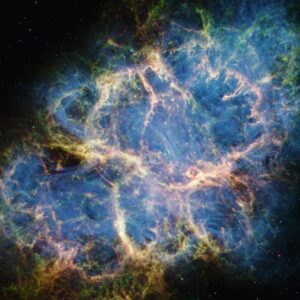
Crab Nebula: NASA/ESA/CSA James Webb Space Telescope
The first pulsar was discovered by Jocelyn Bell Burnell in 1967.
She discovered its pulsing radio waves coming from the Crab Nebula.
The Crab is the remains of a star which exploded in the year 1004.
Named PSR B1919+21, The Crab pulsar spins 30 times per second.
Black Holes
Neutron stars result from the explosion of supermassive stars.
But there is another possible fate for a superstar.
That is to end its life as the smallest star remnant – a black hole.
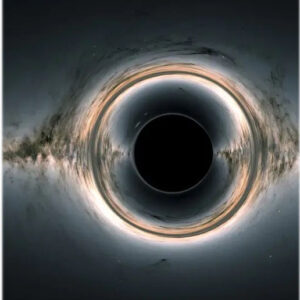
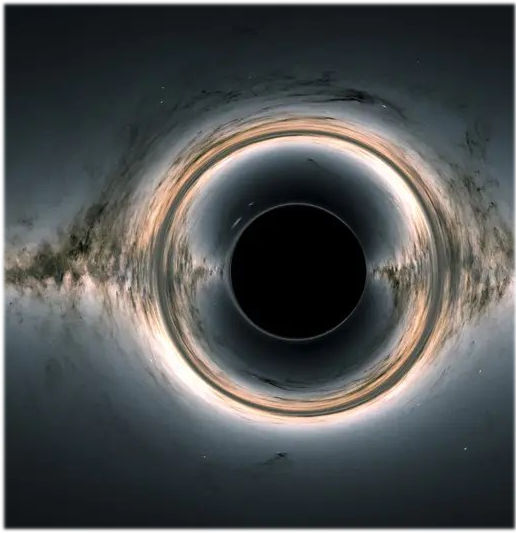
Computer simulated black hole: NASA
A superstar more than three times the mass of the Sun may become a black hole.
The star explodes in a supernova, blasting material into space.
The core collapses in on itself under overwhelming gravity.
It collapses beyond a neutron star, into a point of zero volume but infinite density.
That point is a singularity. That is our smallest star object: nothing can become any smaller.
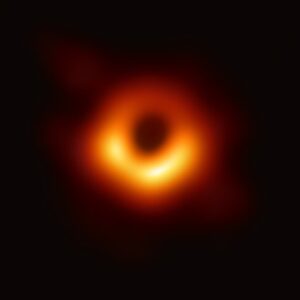
Supermassive Black Hole: The Event Horizon Telescope (EHT)
The singularity has such powerful gravity that nothing can escape from it, not even light.
An area of darkness surrounds it. The edge of darkness is the event horizon.
In a stellar black hole, made from a single star, the event horizon is about 50km across.
The black hole attracts gas and dust from around it.
The gas and dust spins into a glowing accretion disc surrounding the black hole.
Such a disc can be seen in the Event Horizon Telescope’s image of a supermassive black hole.
The Smallest Star
So there it is. We’ve moved down through the cosmic size scale.
The smallest hydrogen-burning, energy-producing star is OGLE-TR-122b, a red dwarf.
But there are smaller star-related objects: brown dwarfs, white dwarfs and neutron stars.
The bottom of the size range really has no size at all.
The smallest star-object is the singularity at the centre of a black hole.
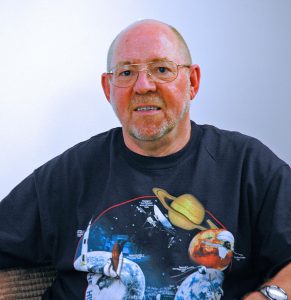
The author: Dennis Ashton, MBE, is a Fellow of the Royal Astronomical Society and a Wonderdome presenter.
In 2024, Dennis received the Special Contribution award from the British Association of Planetaria.
In 2025 he became a Member of the Order of the British Empire for over 50 years work in Astronomy Education.
WonderDome: Leading the Way in Mobile Planetariums
WonderDome offers a fully immersive experience, taking you on a journey through the cosmos. Perfect for all ages and abilities. We now boast a team of 15 presenters, located all over the UK, establishing us as the largest – and best – mobile planetarium organisation in the UK.
Stay Connected for Astronomy News and Events Follow WonderDome mobile planetarium on Twitter / X, Facebook, Instagram and TikTok to stay up to date on the latest news, shows and offers. Or visit our website at wonderdome.co.uk. WonderDome is part of the Service4Education Group