

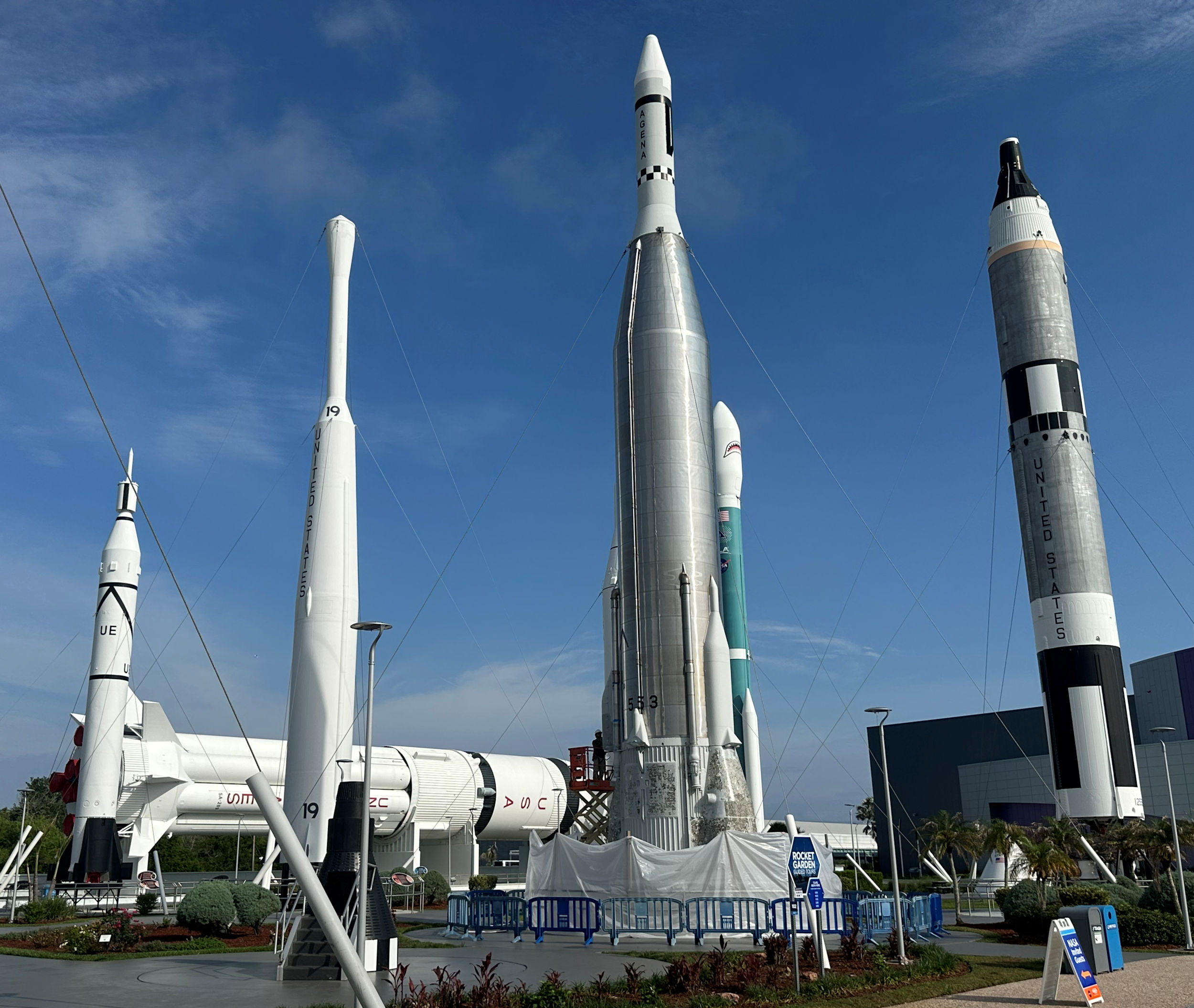
Kennedy Space Centre. The most famous space place in the world.
From Kennedy, humans launched to the Moon.
Space Shuttle missions from Kennedy built the International Space Station.
And Kennedy will soon see astronauts returning to the Moon.
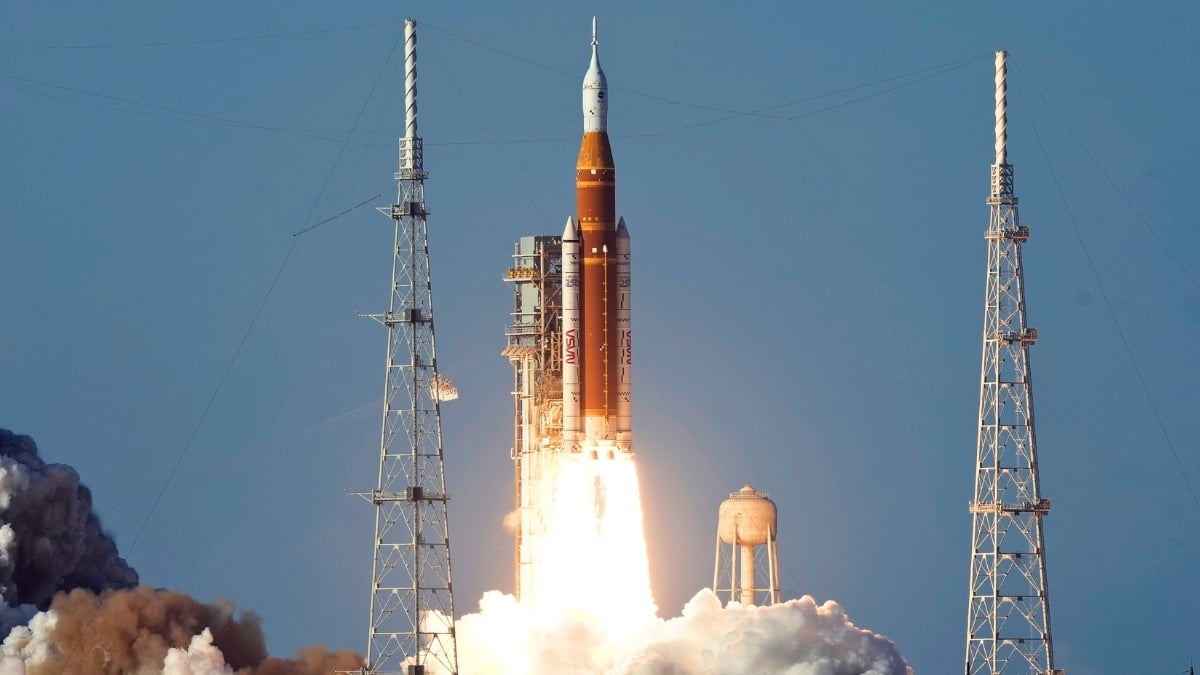
Artemis 2 launch: NASA
A few weeks ago I was in Florida and visited the Kennedy Space Centre.
It was my second visit. My first was back in 1994.
The visitor experience has changed a lot in those 32 years.
In my next two blogs, I’ll give a guide to the Space Centre and compare my two visits.
In part one we’ll take the extended bus tour to famous landmarks.
Then, in part two, we’ll look at the Visitor Centre.
Location
Kennedy Space Centre is on the Atlantic coast of central Florida.
It’s about an hour’s drive from Orlando airport.

The centre is on Merrit Island, to the west of Cape Canaveral.
The location means that rocket trajectories are directed over the Atlantic Ocean rather than over land.
Our tour guide Richard told us this story of how the Cape came to be America’s primary launch site.
Death in Mexico.
The original launch base for American rockets was the White Sands Missile Range in New Mexico.
It was used after World War 2 to test captured German V2 rockets.
In May 1947, one of the rockets veered off course and crashed near Juarez in Mexico.
The impact left a crater 50 feet across and 25 feet deep.
And worse, dead bodies were strewn all around the impact site.
But nobody died! The rocket had crashed in a cemetery!
Obviously, the crash could have had much more serious consequences.
To avoid a future international confrontation, the American military looked for another launch site.
It would have to take rockets away from inhabited areas.
Like over the ocean. Cape Canaveral was chosen.
History
Cape Canaveral was used by the US mlitary as a launch base as early as 1949.
In 1962, NASA chose the Cape as its Launch Operations Centre, LOC, for the Apollo Moon landings.
They set up the LOC on Merritt Island, adjoining Cape Canaveral.

JFK speech ‘We choose to go to the Moon’, September 1962.
President Kennedy visited the centre in November 1963, a week before he was assassinated in Dallas.
New president Lyndon Johnson officially named the centre for JFK shortly after.
My Visit
Before our visit, we booked the explore bus tour.
This takes visitors out of the Visitor Centre to see historic launch pads and the Vehicle Assembly Building.
We walked through the Rocket Garden to catch our 9.30am bus.
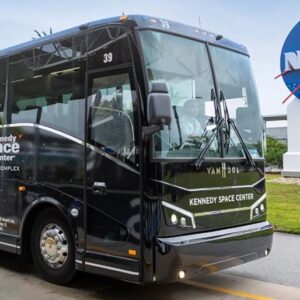
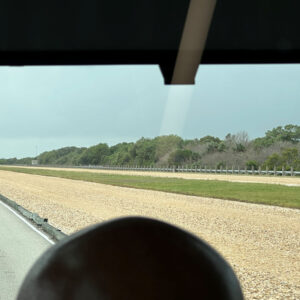
A comfortable air-conditioned bus took us by the side of the crawler track that takes rockets out to the launch pads.
The double track is much wider and longer than you imagine from TV images.
Our first stop was the Gantry at Launch Complex 39.
The Gantry at LC-39

At the Gantry, there’s an information centre and a dummy rocket ‘launch’.
The 4-story structure gives panoramic views of the Kennedy Space Centre.
It’s also a viewing base for launches from Cape Canaveral.
We looked across to the Cape to see a Space-X rocket ready for launch that evening.
More of that later.
Launch Complex 39
Our next stop was at the legendary Launch Complex 39.
This is where Apollo missions to the Moon lifted off.
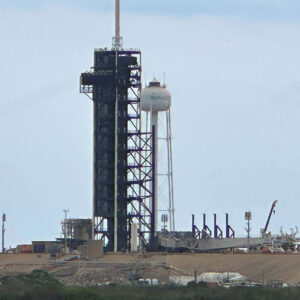
Launch pad 39B
It’s where the space shuttle missions launched.
Now It’s the site for Artemis launches.
Launch Complex 39 is the most famous launch facility in the world.
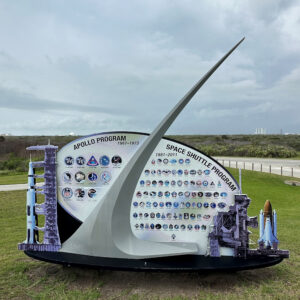
Mission marker, LC-39
Artemis Launch Pad 39
The Artemis launch pad has no fixed gantry.
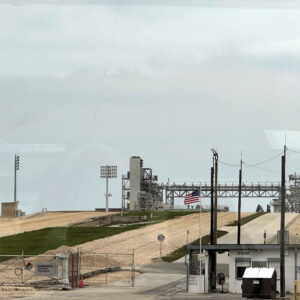
Artemis launch pad
Instead, the Space Launch System rocket is wheeled out on the crawler with the launch gantry attached.
But seeing the size of the twin crawler tracks gives some impression of how big these new Moon rockets must be.
Back in 1994, we couldn’t get near Launch Complex 39.
The Space Shuttle Endeavour was there, ready for launch the next day.
And we would be there! Again, more of that later.
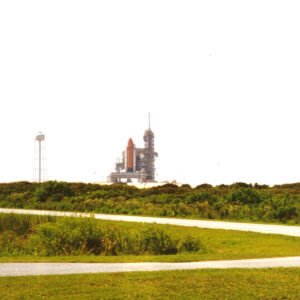
Space Shuttle Endeavour at LC-39 in 1994.
On our return to the Visitor Centre, we stopped at the Vehicle Assembly Building, VAB.
The VAB was built in 1966 to house the Saturn V rocket, assembled vertically.
It’s enormous. At 525 feet tall, the VAB is the largest single-story building in the world.
The two grey doors, on the left of my photo below, are the biggest in the world at 456 feet high.
It takes 45 minutes to open and close them.
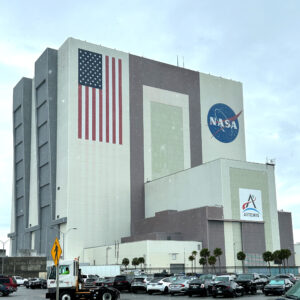
Vehicle Assembly Building
Even when you’re there, it’s difficult to appreciate the scale of the VAB.
To give you some idea, look at the stars & stripes flag painted on the side of the building.
Each star is 6 feet across, each stripe is 9 feet wide.
The blue star background is the size of a basketball court.
The next photo shows how the VAB and LC-39 are connected by the twin crawler tracks.
The tracks are 3.5 miles long. It takes around 8 hours for rockets to make the journey.

VAB and LC-39: NASA
Our bus tour took around a couple of hours and returned us to the Visitor Centre.
It had taken us to historic, iconic sites at Kennedy.
It was a vivid taste of space history and stories yet to be told.
A tale of two launches
Space Shuttle Endeavour, August 18th, 1994
I first visited the Kennedy Space Centre in August 1994.
Space Shuttle Endeavour was scheduled to launch on August 18th.
That was the last day of our holiday – so we would see a launch!
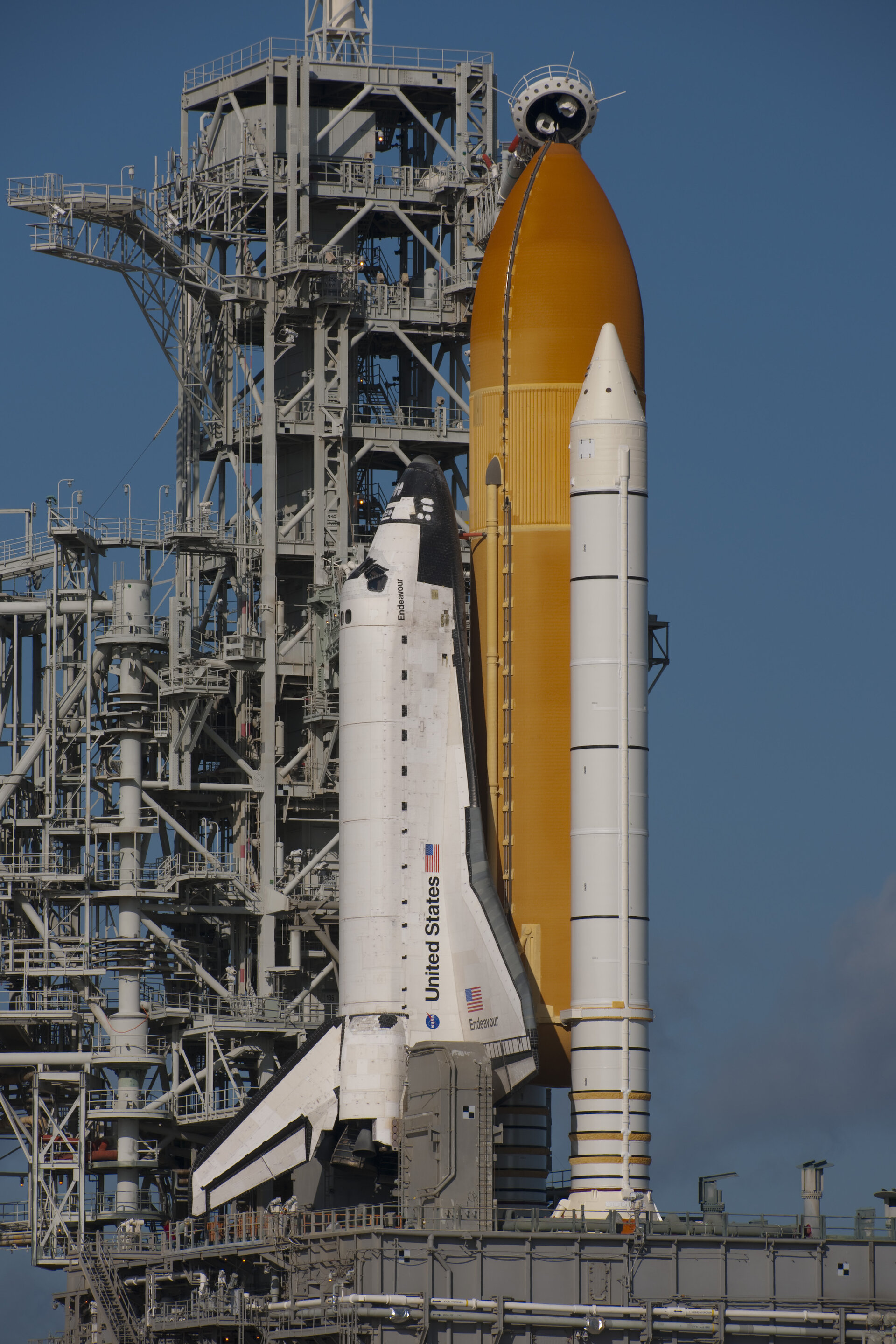
Space Shuttle Endeavour on Launch Pad 39A: NASA
Lift off was planned for around 7am, as far as I can remember.
Our tickets were for a prime viewing area, just 3 miles from the pad.
We arrived at 3am in the dark and settled down for dawn to arrive.
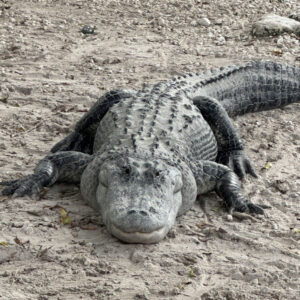
To pass the time we chatted with fellow spectators and watched for alligators in the lake.
The countdown clock ticked off the hours, minutes and seconds.
Dawn broke and the clock reached minus 10 seconds.
At T-7 seconds, smoke erupted from the launch pad.
Everyone was standing, focussing on Launch Pad 39.
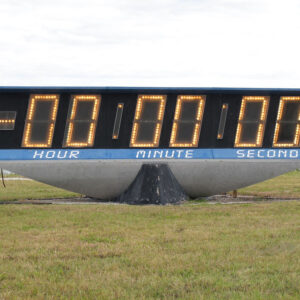
The countdown reached T-1 seconds – and stopped!
Endeavour would not go today.

Space Shuttle launch abort: NASA
We walked away with the crowd, disappointment etched on everyone’s face.
But with that disappointment was a quiet relief.
The Challenger disaster was still fresh in our memories.
At least no brave astronauts would die today.
Launch 2: Space X Falcon 9
There were no launches from Kennedy Space Centre during our time in Florida.
But there was a launch scheduled from nearby Cape Canaveral.
This was a Space X Falcon 9 rocket taking a Dragon cargo vessel to the International Space Station.
We had seen the rocket on its pad from the Gantry on our bus tour.
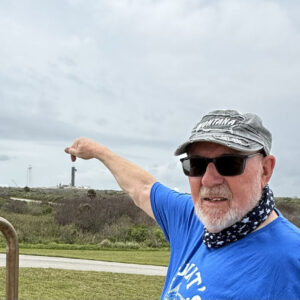
Falcon 9 rocket on launch pad, seen from the Gantry.
The launch would be just after 6pm.
By this time we were back at our hotel on Cocoa Beach.
We planned to watch the launch from the pier.
As you can see in the photo, the pier would give us a great view of the launch.
The launch complex is only 5 miles away and is a famous local viewing place for the Cape.
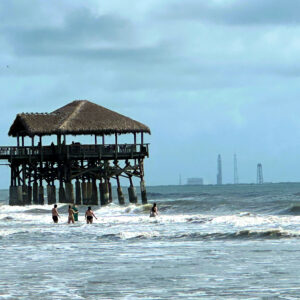
Cocoa Beach
Sadly, fate intervened again.
Having had no rain for three weeks, thunderclouds built up during the afternoon.
The possibility of lightening meant that the launch would be scrubbed.
In the event, the heavens opened and a storm swept across Cocoa Beach.
We could hardly see the pier, never mind the Cape!
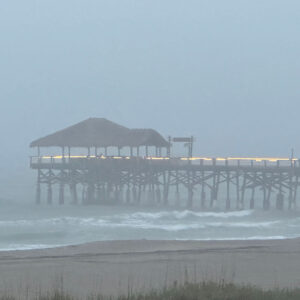
Launch time, Cocoa Beach pier.
Two days later the rocket launched under sunny skies and delivered its cargo safely to ISS.
By that time we were back home in England.

Falcon 9 launch from Cape Canaveral, May 15th
An unenviable record
So I have a 100% record in not seeing rocket launches.
Two launches attended, two scrubbed, no launches seen. Yet.
Perhaps I might be around to see Artemis 4 launch to the Moon.
That would really be third time lucky!
Next Time
In my next blog, I’ll write about the Visitor Centre at Kennedy.
There have been many changes since 1994.
The centre has become a theme park, like Disney and the others around Orlando.

Is this a good thing or does it trivialise the greatest space place in the world?
Find out soon!
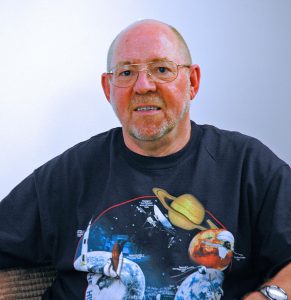
The author: Dennis Ashton, MBE, is a Fellow of the Royal Astronomical Society and a Wonderdome presenter.
In 2024, Dennis received the Special Contribution award from the British Association of Planetaria.
In 2025 he became a Member of the Order of the British Empire for over 50 years work in Astronomy Education.
WonderDome: Leading the Way in Mobile Planetariums
WonderDome offers a fully immersive experience, taking you on a journey through the cosmos. Perfect for all ages and abilities. We now boast a team of 15 presenters, located all over the UK, establishing us as the largest – and best – mobile planetarium organisation in the UK.
Stay Connected for Astronomy News and Events Follow WonderDome mobile planetarium on Twitter / X, Facebook, Instagram and TikTok to stay up to date on the latest news, shows and offers. Or visit our website at wonderdome.co.uk. WonderDome is part of the Service4Education Group