

The Question
Very often in Wonderdome, a youngster says ‘there’s no gravity in space’.
We’ve even had adults confidently claim that there’s no gravity on the Moon.
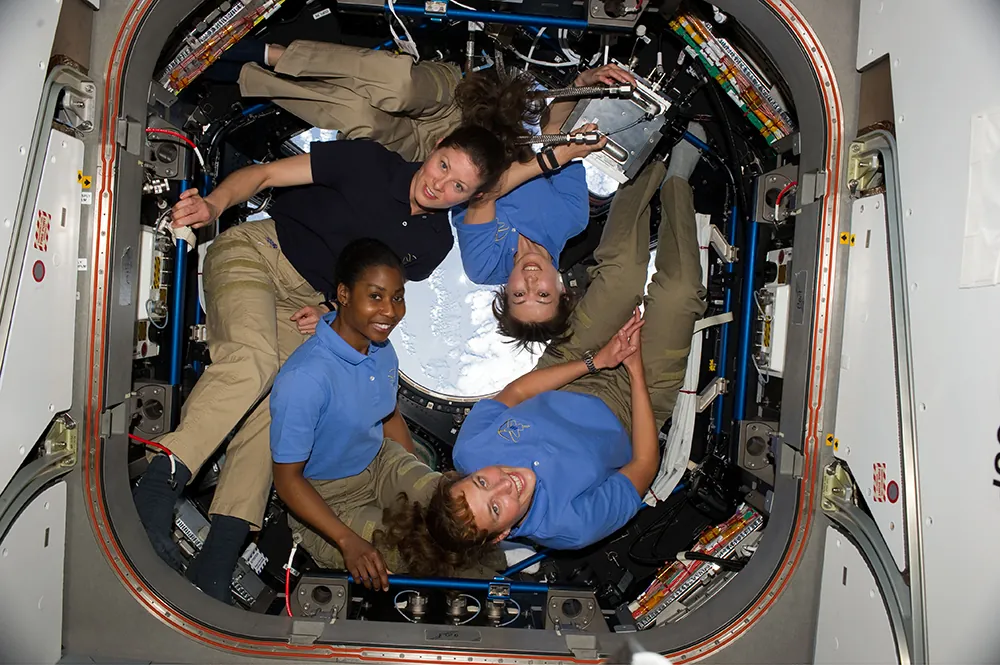
They’ve seen videos of astronauts floating in a spacecraft, weightless.

Astronaut in ISS: NASA
Astronauts even call it ‘microgravity’.
In this blog we’ll take a look at gravity.
And we’ll have some fun facts about this universal force.
So, let’s answer the question.
Is there gravity in space?
The Answer
Yes! The answer is simple. There is gravity in space.
In fact gravity is everywhere in space.

Galaxies in the Webb Deep Field: NASA
But why do astronauts float in ‘microgravity’.
Let’s take a closer look at gravity.
Gravity and mass
Anything that has mass – is made of stuff – exerts a gravitational pull.
A book, a pen, an apple, you, me, my car, a gatepost, all create gravity.
But with these small objects, their gravity is weak.
I couldn’t claim that I hit a gatepost with my car because gravity pulled them together.
It’s only when we look at very large masses like stars, planets and moons that gravity shows its effect.
Some rules of gravity
- The more mass, the stronger the pull: planets pull much more than people.
- The closer together, the stronger the pull: Gravity gets weaker the farther the distance.
- Gravity pulls from the centre: of stars, planets and moons. At the moment you’re being pulled toward the centre of the Earth.
- Gravity is always there: it works across the whole universe, always.
So why do astronauts float?
The International Space Station shows gravity in action.
The gravity of Earth keeps the station in orbit.
It orbits the Earth at an altitude of 400 km, 250 miles.
At that height, the gravitational pull of Earth is 90% as strong as it is on the ground.
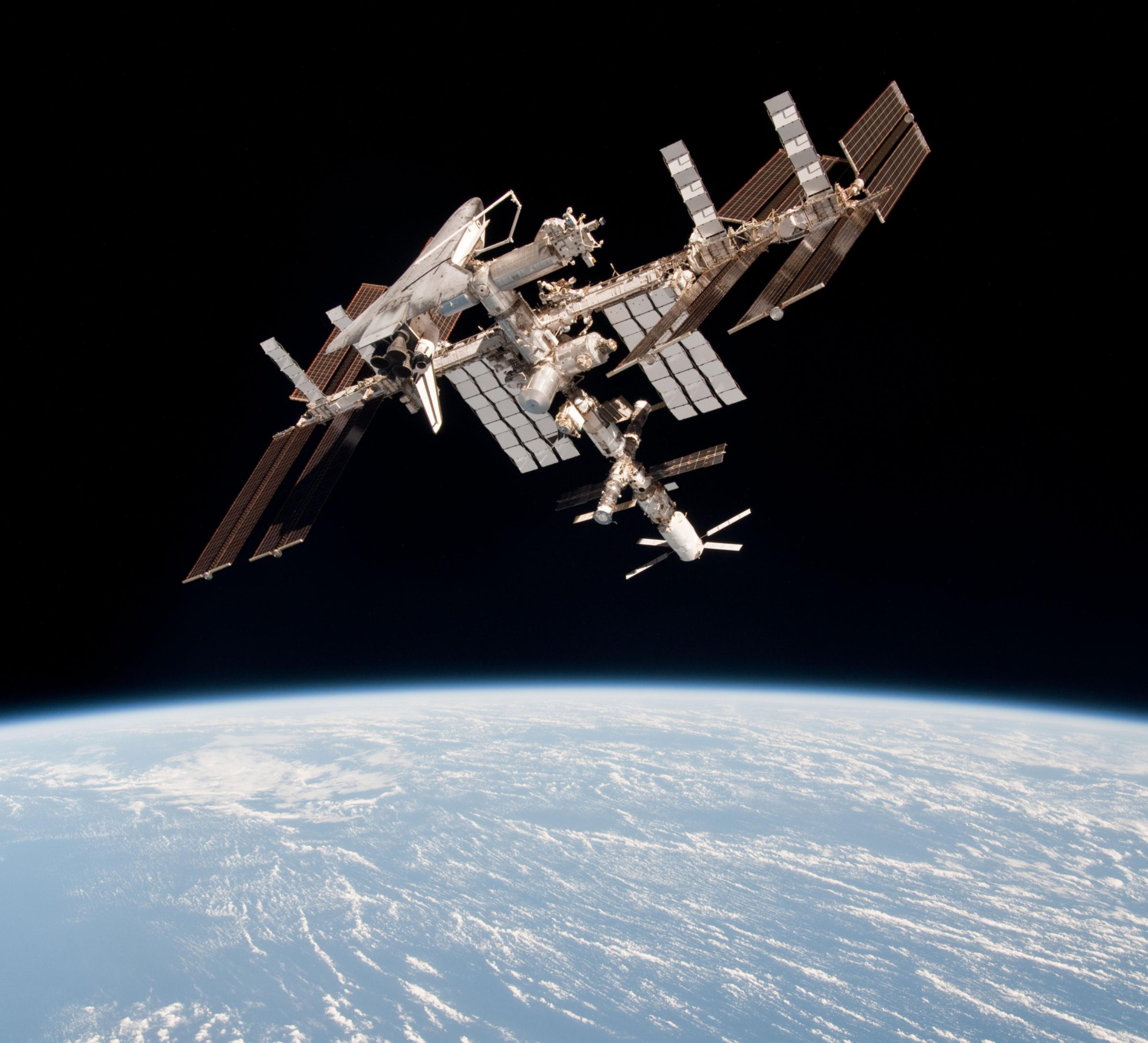
The station is travelling around Earth at 25,000 km per hour, 17,500 mph.
This speed balances the force of Earth’s gravity.
As the station falls towards Earth, our planet curves away beneath it.
Inside the station, things are in free fall.
The walls, the floors, the air, the equipment, the astronauts all fall together.
There’s no push-back from the floor, it feels like no gravity at all.
The astronauts float, they are weightless.
Astronauts on the International Space Station: NASA
On the Moon
Another misconception we sometimes hear is that there’s no gravity on the Moon.
That’s clearly nonsense. If it were true, the astronauts and their landers would float away into space.
Apollo 16 on the Moon: NASA
What is true is that gravity is less on the Moon.
Our Moon is smaller than Earth and has a mass six times less.
So gravity on the Moon is six times less than Earth gravity.

Apollo 15 Moon buggy: NASA
If you look carefully at astronauts jumping or driving on the Moon, you see it.
The dust from boots and wheels falls back in slow-motion.
Gravity on other worlds
Planets are different sizes, different masses. So their gravity is different.
Mars, for example, has 40% the mass of Earth so it has only 40% of Earth’s gravitational pull.
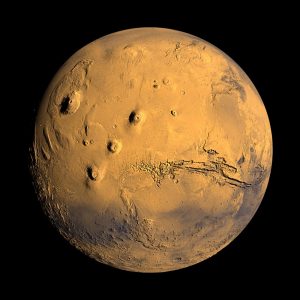
Mars: NASA
A person who weighs 10 stones on Earth would weigh only 4 stones on Mars.
Jupiter, although 1,200 times the size of Earth, has 2.5 times Earth gravity.
That’s because it’s made mainly of gas and is not very dense.
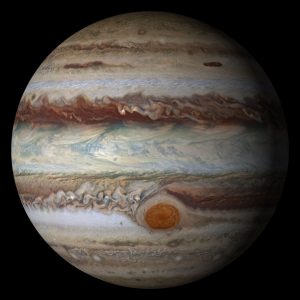
Jupiter : Voyager, NASA
So the 10 stone person would weigh 25 stones on Jupiter.
That’s of course if Jupiter had a surface, which it doesn’t.
Gravity, mass and weight
That brings us nicely to consider the relationship between gravity, mass and weight.
Mass is a measure of how much matter an object contains.
Mass stays the same no matter where you are, on Earth, the Moon or in space.
Weight is the force exerted on a mass by gravity.
It’s value can change. It depends on the mass of an object and the local gravitational pull.
So things weigh less on the Moon but their mass is the same.
Fun facts about gravity
Gravity is the weakest fundamental force in nature:
But it works over the longest distance, reaching across the entire universe.

Galaxies: NASA / HST
You weigh less at the top of a mountain than at sea level:
You are further away from the centre of the earth so the pull is slightly weaker.

Gravity causes the tides:
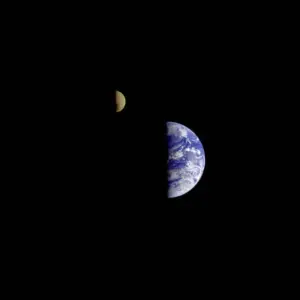
The Earth’s gravity holds the Moon in orbit.
And the gravity of the Moon pulls Earth’s ocean water towards it.
As Earth rotates, the sea level rises and falls.
At the shore we see high tide and low tide.

The Moon is moving away
The tidal forces are pushing the Moon away from Earth.
The movement is tiny. The Moon drifts away from us 3.8 centimetres each year.
That’s about as fast as your fingernails grow!
Next time
So far we’ve considered the effects of local gravity.
Next time we’ll see how gravity works and how it shapes the whole universe.
The author: Dennis Ashton, MBE, is a Fellow of the Royal Astronomical Society and a Wonderdome presenter.
In 2024, Dennis received the Special Contribution award from the British Association of Planetaria.
In 2025 he became a Member of the Order of the British Empire for over 50 years work in Astronomy Education.
WonderDome: Leading the Way in Mobile Planetariums
WonderDome offers a fully immersive experience, taking you on a journey through the cosmos. Perfect for all ages and abilities. We now boast a team of 15 presenters, located all over the UK, establishing us as the largest – and best – mobile planetarium organisation in the UK.
Stay Connected for Astronomy News and Events Follow WonderDome mobile planetarium on Twitter / X, Facebook, Instagram and TikTok to stay up to date on the latest news, shows and offers. Or visit our website at wonderdome.co.uk.
WonderDome is part of the Service4Education Group