

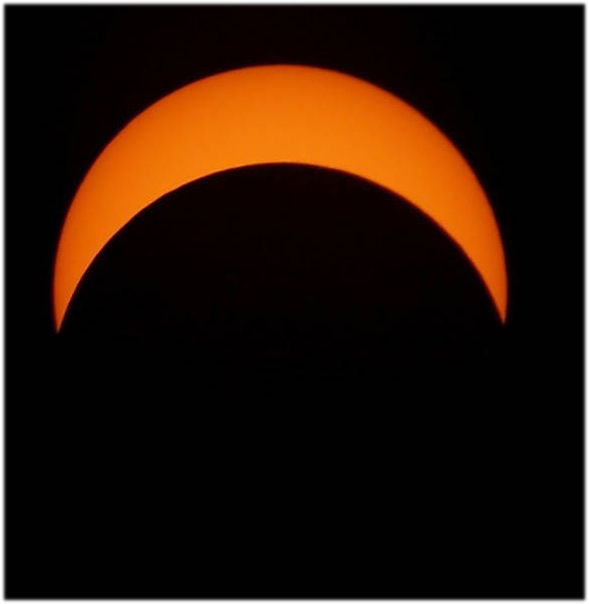
On August 12th, an eclipse of the Sun comes to Europe.
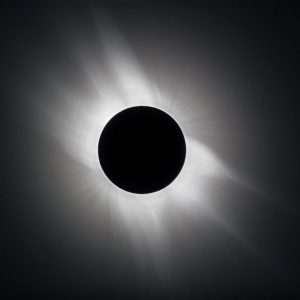
There’s a catch, of course.
The total eclipse will be seen in Greenland, Iceland and Spain.
For the rest of us it will be a partial eclipse.
It’s a good partial eclipse though, with about 90% of the Sun covered by the Moon in the UK.
In this blog we’ll look at some significant historical eclipses.
Then in the following two blogs we’ll discuss how to view the August event safely.
A Solar Eclipse
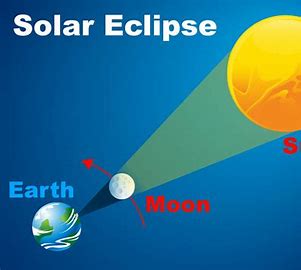
An eclipse of the Sun occurs when the Moon moves in front of the Sun as seen from Earth.
The Moon casts a tiny shadow. Inside that shadow, we see an eclipse.
As the Sun and Moon move across the sky, the Moon shadow tracks across our planet.
In a cosmic coincidence, the Sun and Moon are about the same size from our viewpoint.
The Moon is 400 times smaller than the Sun – but 400 times nearer to us.
So their sizes look the same to us.
What we see
A partial eclipse is interesting, worth taking some trouble to observe.
But when the Moon covers only part of the Sun’s disc, it doesn’t go dark.
We need some equipment to observe it without damaging our eyesight.
In our next blog we’ll see how to do that.
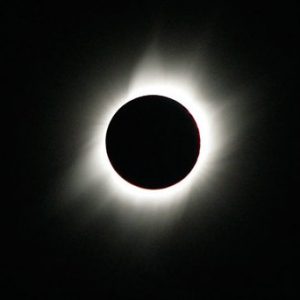
A total solar eclipse is one of nature’s wonders.
The sky goes dark in daytime. Planets and stars appear.
It’s sunset all around the horizon.
It’s a mystical, memorable event.
Eclipses in history
Solar eclipses have been seen and recorded over the last 5,000 years.
They are so dramatic that they have influenced culture, science and historical events.
We’ll take a look at some of these dramas and their effects on our history.
3340 BC: The earliest record of an eclipse?
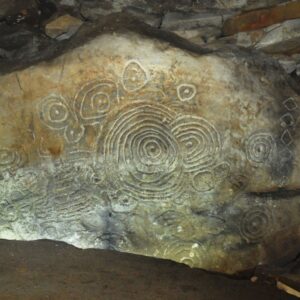
The earliest known record of a solar eclipse is at Loughcrew Cairn in Ireland.

On stones there, spiral petroglyphs are said to represent a total eclipse.
Modern calculations indicate that an eclipse was seen in Ireland in 3340 BC.
2134 BC: Astronomers lose their heads
The ancient Chinese learned how to predict solar eclipses.
They thought that an eclipse had an effect on the health and wealth of the Emperor.
When an eclipse was expected, an elaborate ceremony would take place.
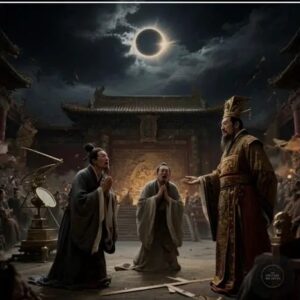
The astronomers tasked with predicting eclipses at the time were Hsi and Ho.
Unfortunately, the story goes, they failed to predict the eclipse of 2134 BC.
The emperor was so angry, he had the pair executed for their incompetence.
The eclipse certainly affected the health of the poor astronomers!
The story is disputed but it remains one of the earliest records of a total eclipse of the Sun.
585 BC: the eclipse that stopped a war
On May 28th, 585 BC two armies prepared for battle.
The forces of King Alyattes of Lydia and King Cyaxares of the Medes lined up to fight.
The two kingdoms, in what is now Turkey and Iran, were about to settle a five-year conflict.
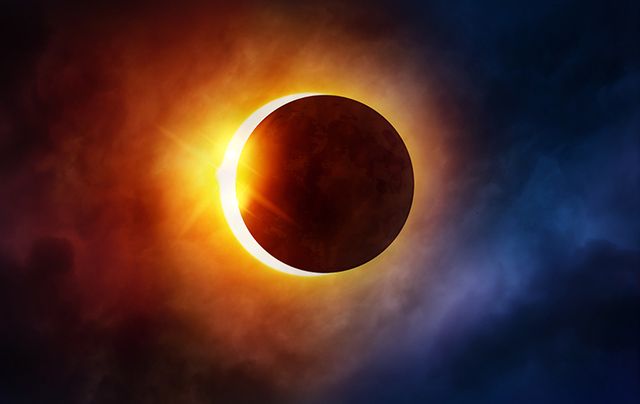
As the battle began, the sky darkened. The Moon obliterated the Sun.
Both sets of soldiers panicked.
They saw the eclipse as divine condemnation.
The fighting stopped and amazingly both sides came to a peaceful settlement.
The eclipse had stopped a war.
June 18, 1806: The Crown
We’ll now jump ahead to more recent times and to the USA.
In 1896 the path of totality ran from Arizona to Maine.
Astronomer Jose Joaquin de Ferrer observed the eclipse from New York.
He named the Sun’s white glow around the Moon the ‘Corona’, the crown.
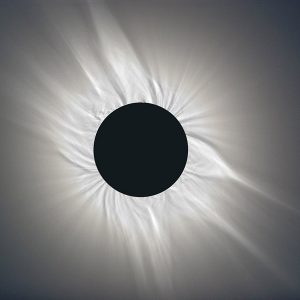
He proposed that the corona must belong to the Sun, not the Moon, because of its size.
The corona represents the outermost layer of the Sun’s atmosphere and can only be seen during a total eclipse.
May 15th, 1836: Baily’s Beads
Just before totality, we see the beautiful ‘diamond ring’.
The ‘diamond’ represents the last sliver of sunlight before the Sun disappears behind the Moon.
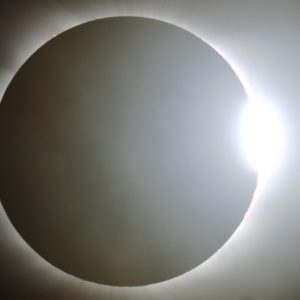
As the ring disappears, small flashes of light appear in place of the gemstone.
Astronomer Francis Baily worked out why.
These points of light were caused by sunlight shining through valleys of the Moon.
They are now known as ‘Baily’s Beads’.
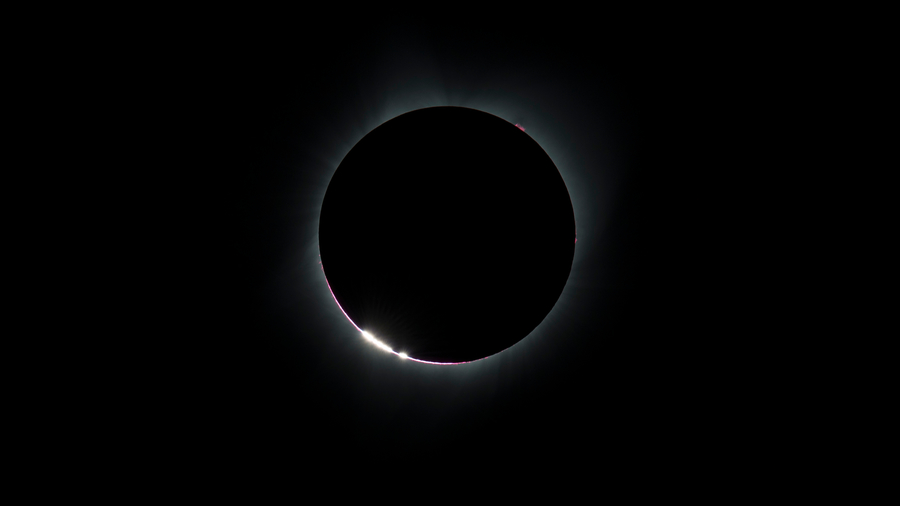
Baily’s Beads: NASA/ Aubrey Gemignani
July 28th, 1851: First photo
The first photograph of a total eclipse was taken by Johann Berkowski.
He used a small 2.4-inch refractor telescope at the Royal Observatory in Königsberg, Prussia.
He connected a camera that held a daguerreotype plate to the telescope and made an 84-second exposure.
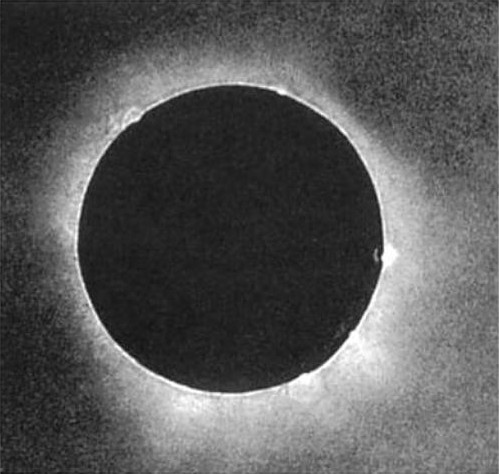
First eclipse photograph. Credit: Julius Berkowski/Wikimedia Commons
August 18th, 1868: A new element
By now, solar eclipses sent astronomers on worldwide expeditions.
French astronomer Pierre Janssen observed the eclipse from India.
He used a spectroscope attached to his telescope.
In the corona he recorded a spectral line never seen before.
Meanwhile, a British astronomer, Norman Lockyer had seen the same lines.
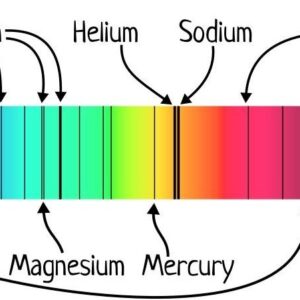
Part of the solar spectrum
Lockyer concluded that he had found a new element – in the Sun.
He named it helium after the Greek word helios, meaning the Sun.
Both Janssen and Lockyer share the credit for the first element discovered outside the Earth.
May 29th, 1919: Einstein was right
In 1916, Albert Einstein published his General Theory of Relativity.
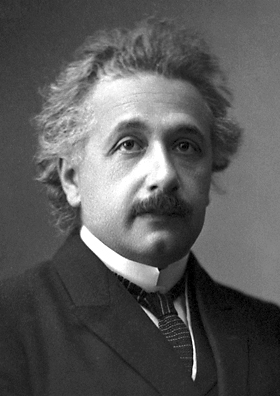
Albert Einstein, official portrait as 1921 Nobel Prize winner.
The theory stated that space-time is distorted by mass.
An object like a star or planet would cause space to curve.
So the Sun would bend light from stars behind it.
In theory you would be able to see stars hidden by the Sun.

A total eclipse was the perfect means to actually do this.
Led by Arthur Eddington, two British teams set off to Brazil and West Africa to observe the eclipse.

Eclipse equipment, 1919, in Sobral, Brazil.
They photographed the stars seen at totality.
Then they compared the positions of the same stars on photos taken at night.
Sure enough, the stars had changed position slightly.
The change was close what Einstein’s theory predicted.
The 1919 eclipse showed that Einstein was right, gravity bends light.
The results changed Physics and enhanced Einstein’s growing public reputation as scientific genius.
August 11th, 1999: a UK eclipse
This total eclipse clipped the south-west of England before tracking across Europe.
The English weather tried its best to spoil the show.
In most of Cornwall and Devon, clouds covered the eclipsed Sun.
However on the Lizard and in Perranporth, the clouds cleared briefly to give spectators a glimpse of totality.
1999 eclipse: Steve, Dennis, Paul & Ollie
I was lucky. Four of us had booked on board a ship to sail into the English Channel.
Here the clouds cleared well before the total eclipse.
I had my first ever experience of the magic of the Sun disappearing in daytime.
It was awesome, spectacular and mystical. A day to remember.
The next UK total eclipse
The next total eclipse of the Sun in Britain will follow a similar track to the 1999 event.
It will cross parts of Devon and Cornwall, together with the Isle of Wight.
We’ll have to wait a while though.
The date is September 23rd, year 2090!
I doubt I’ll see this one.
Eclipse 2026, August 12th
This year’s eclipse will pass over Greenland and western Iceland.
It will then traverse the Atlantic Ocean to cross Northern Spain before sunset.
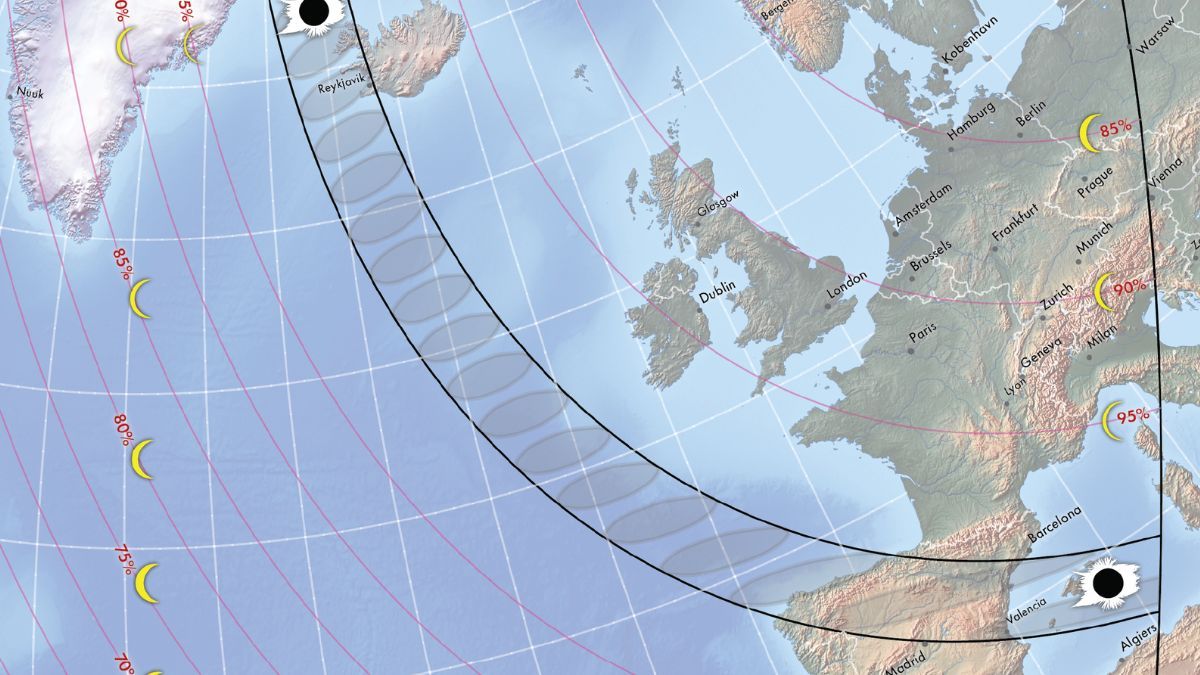
In the UK we will not witness totality. Our sky will not go dark.
However it will be a significant partial eclipse,.
Around 90% of the Sun will be covered by the Moon.
In our next blog, I’ll detail some ways that we can view the event safely.
In the meantime, enjoy the summer sun!
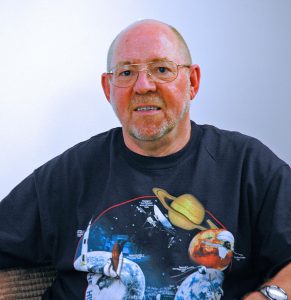
The author: Dennis Ashton, MBE, is a Fellow of the Royal Astronomical Society and a Wonderdome presenter.
In 2024, Dennis received the Special Contribution award from the British Association of Planetaria.
In 2025 he became a Member of the Order of the British Empire for over 50 years work in Astronomy Education.
WonderDome: Leading the Way in Mobile Planetariums
WonderDome offers a fully immersive experience, taking you on a journey through the cosmos. Perfect for all ages and abilities. We now boast a team of 15 presenters, located all over the UK, establishing us as the largest – and best – mobile planetarium organisation in the UK.
Stay Connected for Astronomy News and Events Follow WonderDome mobile planetarium on Twitter / X, Facebook, Instagram and TikTok to stay up to date on the latest news, shows and offers. Or visit our website at wonderdome.co.uk.
WonderDome is part of the Service4Education Group