

In our last blog, we explored gravity.
We looked at gravity as it affects astronauts, their spacecraft, the Earth and the Moon.
Now we’ll review gravity in wider space, the whole universe.
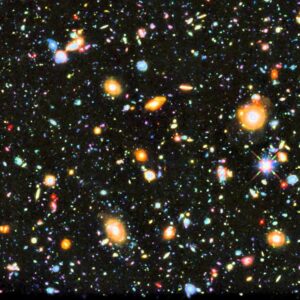
Hubble Deep Field of galaxies: NASA/HST
And we’ll finish with some of the strange effects of gravity.
Welcome to Gravity and Space part 2.
Universal Gravity
Gravity shapes the large-scale universe.
Its infinite reach makes it the dominant force across astronomical distances.
Gravity holds planets in orbit.
It pulls gas and dust together to form stars and planets.
It builds galaxies and draws them together in the cosmic web of the universe.
How gravity works
Two great theories have explained how gravity acts.
Though different, both are useful in contemporary science.
Isaac Newton
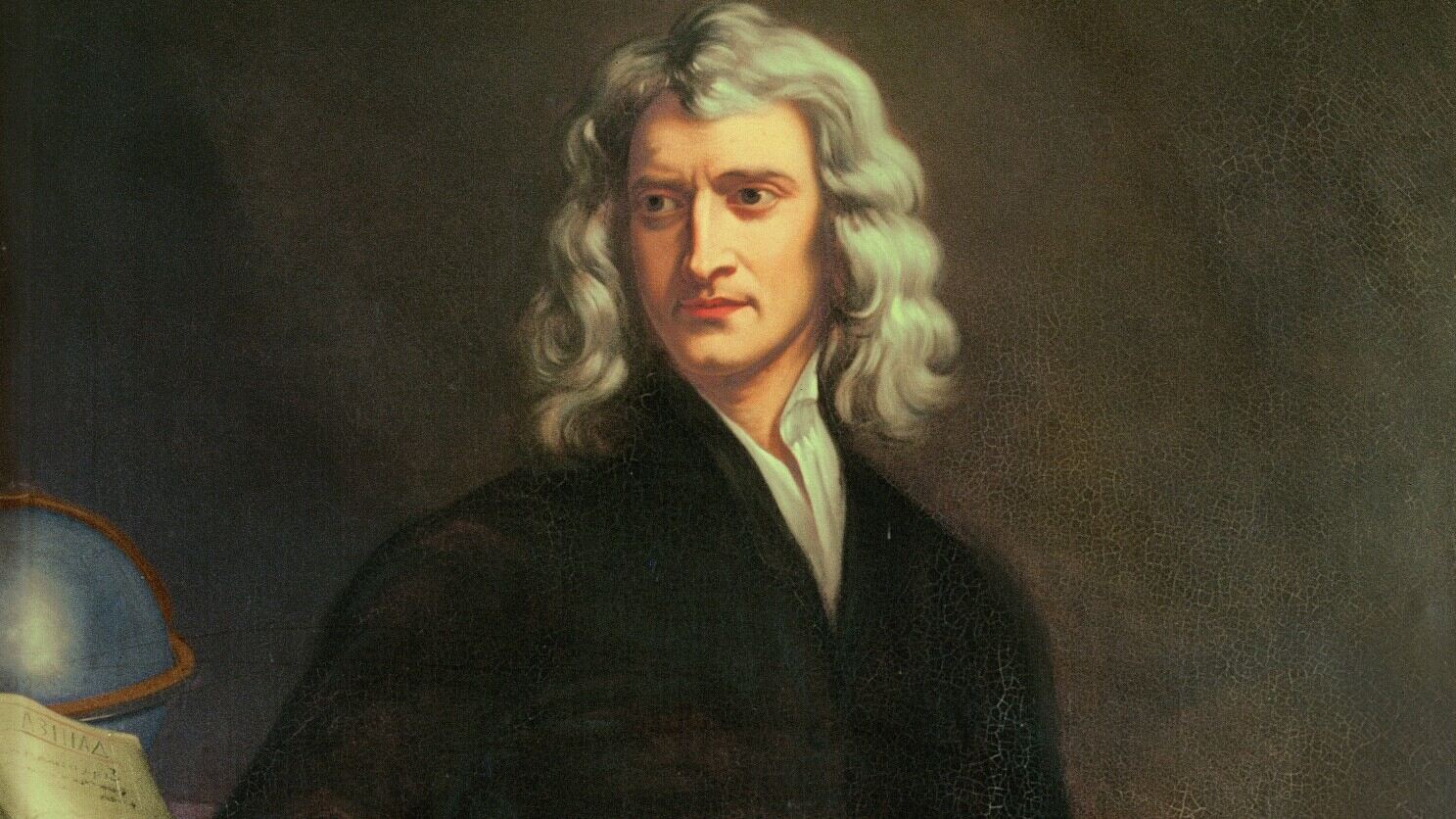
In 1687 Newton published his gravitational theory of Universal Attraction.
This said that gravity is a force that pulls every particle of matter towards every other particle.
All objects with mass attract each other – stars, planets, people, apples.
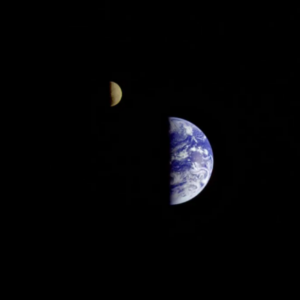
Earth & Moon: NASA / Voyager
Newton said that the greater the mass, the greater the gravitational pull.
And that force increased as the distance between objects decreased.
His formula enabled scientists to explain and predict orbits of planets and moons.
Edmund Halley used Newton’s law to predict the date of the return of the comet named after him.
Albert Einstein
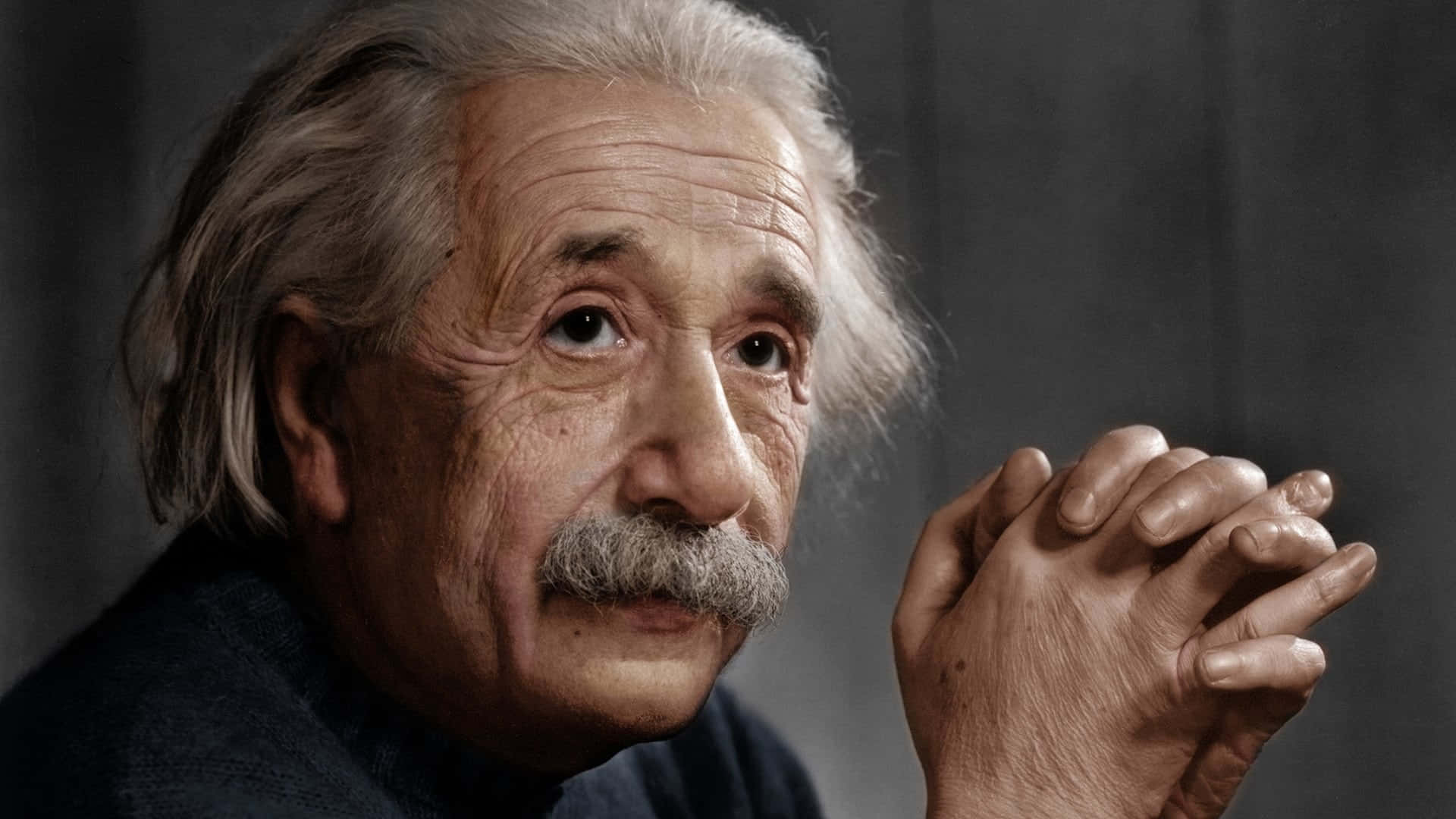
In 1915, Einstein published his General Theory of Relativity.
It is arguably the most important scientific publication of all time.
Spacetime
General Relativity fundamentally redefined gravity.
Under Einstein, the universe is four-dimensional spacetime.
The dimensions of space – length, breadth, depth – are combined with time.
Spacetime is the fabric of the universe.
Spacetime and gravity
Newton’s theory inferred that gravity was a force.
It acted instantly between two objects.
Einstein explained that gravity is not a force.
Huge objects like stars and planets disturb spacetime.

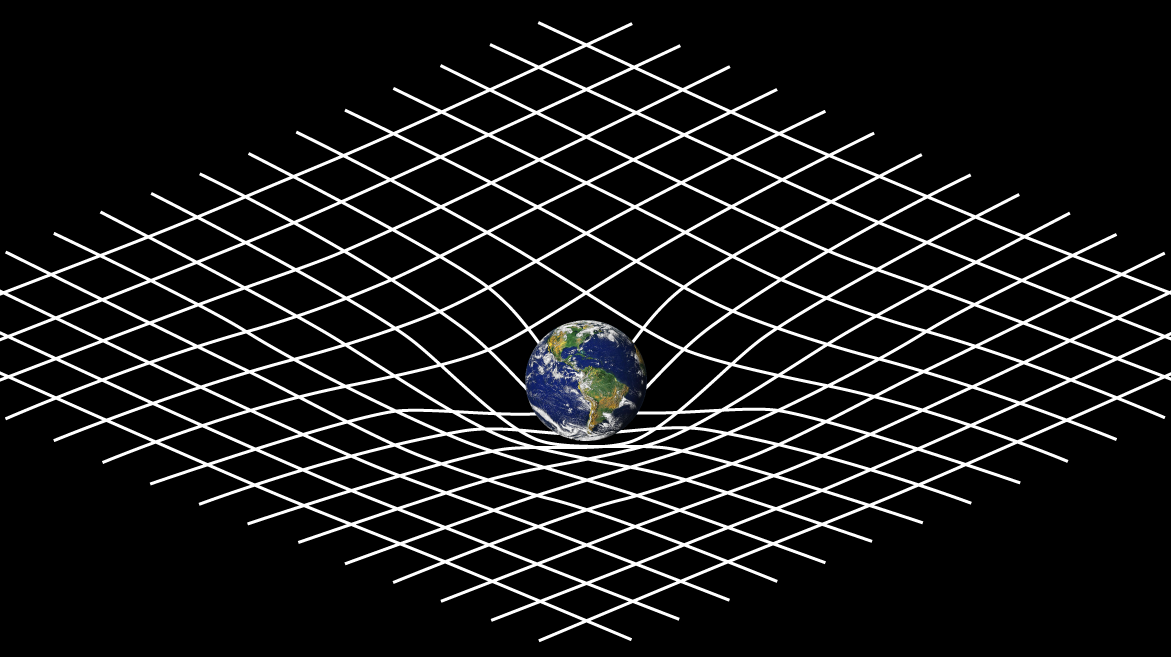
Curved spacetime: NASA
Instead of being flat, spacetime becomes curved.
Objects follow the curvature and experience gravity.
The usual analogy is to show a heavy ball on a stretched rubber sheet.
The ball distorts the rubber sheet.
Any object passing, like another ball, will follow the curvature.
Example: Earth’s orbit
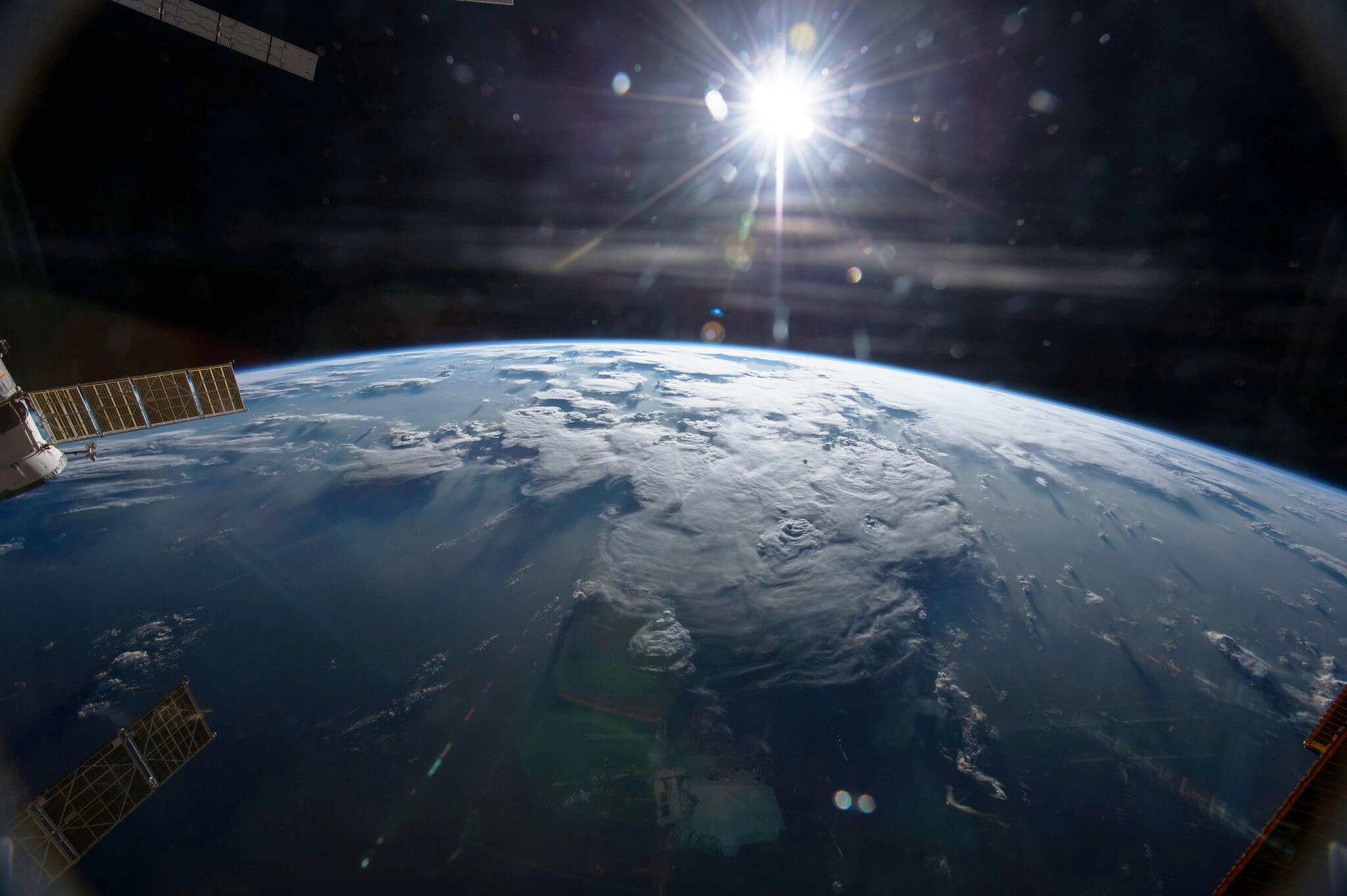
The Sun curves spacetime around it.
This spacetime is curved.
The Earth follows the curvature and moves in orbit around the Sun.
How does gravity travel?
So gravity is a curvature of spacetime around an object.
Each star, planet and moon has a gravitational field around it.
Earth & Moon, Voyager 1: NASA
Changes in a gravitational field cause ripples in spacetime.
These ripples are gravitational waves.
These waves are virtually undetectable unless the masses involved are large.
Colliding neutron stars or black holes can can produce gravitational waves large enough to be detect.
Colliding neutron stars: NASA
Gravitational waves pass through empty space.
They don’t need a medium.
How fast does gravity move?
Speed
Gravity travels at the speed of light.
That’s 300,000 kilometres per second, about 186,000 miles per second.
Putting that in Earth bound terms, that’s an incredible 670 million miles per hour.
Nothing can travel faster.
Evidence
In 2017, the LIGO project observed two neutron stars in the act of colliding together.
The collision produced both gravity waves and gamma rays.
They travelled across 144 million light years of space – and arrived at the same time.
LIGO is the Laser Interferometer Gravitational-Wave Observatory.

LIGO, Hanford, Washington state
Gravity and the Universe
Gravity shapes the cosmos.
Here are some examples of universal gravity.
Creates stars and planets

Starfield: NASA/ESA/ K.Sahu (STsci)
Gravity pulls gas and dust together.
The gas heats up and makes stars.
Left-over gas and dust is pulled together to make planets.
Holds galaxies together
Stars, gas and dust are bound together by gravity.
They form galaxies, cities of stars.
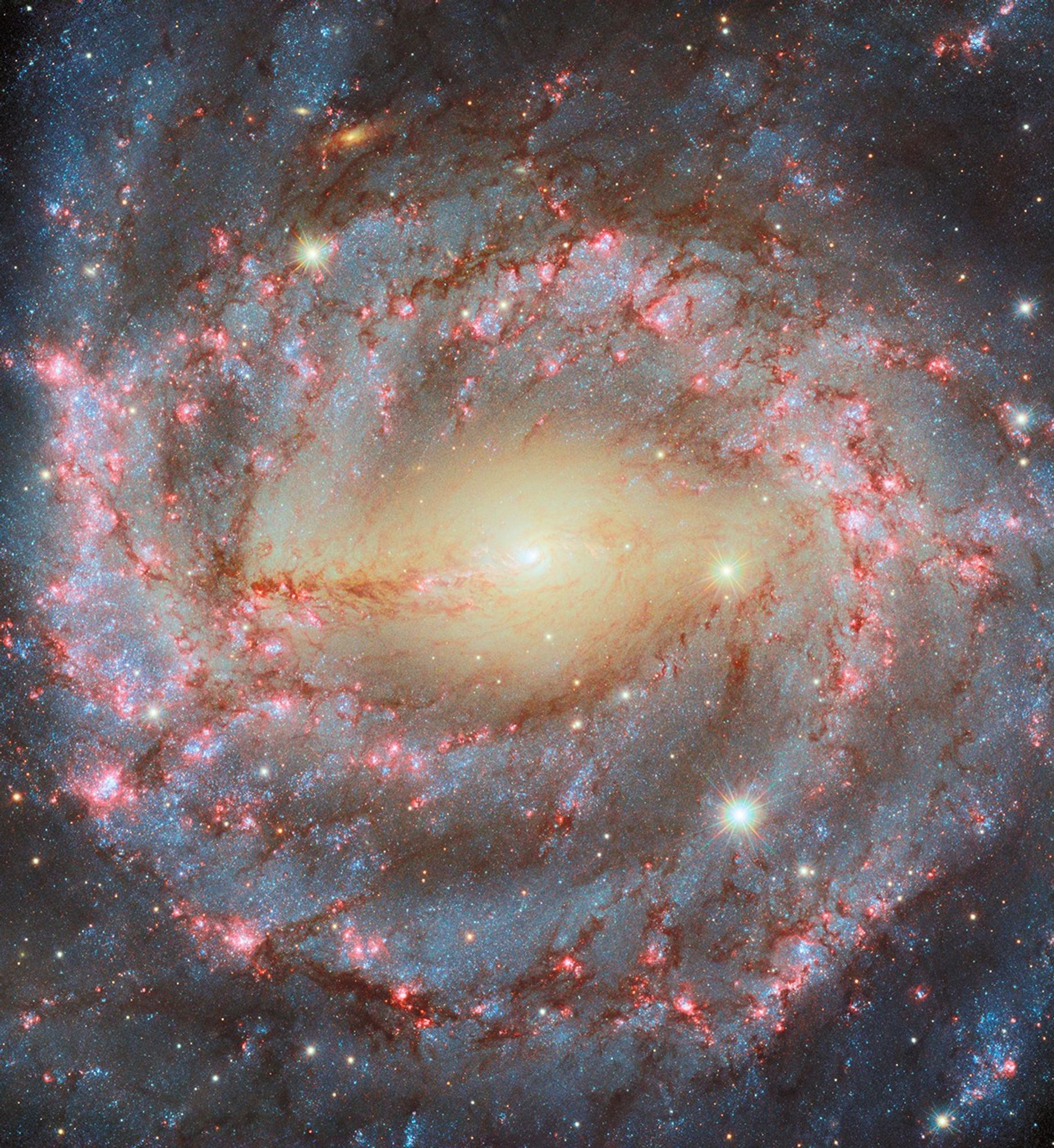
Galaxy: HST / NASA
An invisible substance, dark energy, adds to the mass and the overall gravity of every galaxy.
Supernova remnants
Every galaxy contains superstars, 8 to 20 times the mass of our Sun.
When these massive stars die, they explode as a supernova.

M1, Crab nebula, supernova remnant: NASA / HST
Gravity crushes the middle of the star.
The crushed core forms one of two things – a neutron star or a black hole.
Neutron stars
After the supernova explosion, the crushed core can weigh in at 3 times the mass of the Sun.
Gravity pulls this mass into a small, dense sphere only 20 kilometres across.
Sub-atomic particles, protons and electrons, are crushed together to make neutrons.
Neutrons have no electrical force so they are crushed together with no space between.

Neutron star: ESA
The resulting neutron star is extremely dense.
A teaspoonful of neutron star would weigh about a billion tons!
To escape from the surface of a neutron star, you would need to travel at half the speed of light!
Black Holes
A black hole is the ultimate trick in the gravitational book.
If the collapsed core of the superstar weighs more than three times the mass of the Sun, it collapses completely.
Even the quantum pressure of packed neutrons cannot resist gravity.
The core collapses completely into a tiny point, a singularity.

Supermassive black hole: NASA / ESO
Imagine this full stop . weighing five times more than the Sun!
This tiny point has gravity so high that nothing can escape it.
Even light, the fastest thing there is, cannot escape.
Light and all radiation is trapped, pinned by the singularity.
An area of darkness surrounds the singularity. It is a black hole.
The edge of the darkness is called the event horizon.
Strange effects of gravity
Gravity affects light and time as well as matter.
Gravity and light
Massive objects curve spacetime, warping space around them.
Light travelling through spacetime follows the curve.
Light bends around massive objects.

Gravitational lensing: ESA
The most extreme example is seen with galaxy clusters.
These clusters act like magnifying lenses.
They stretch the light of more distant galaxies into glowing arcs or multiple images.
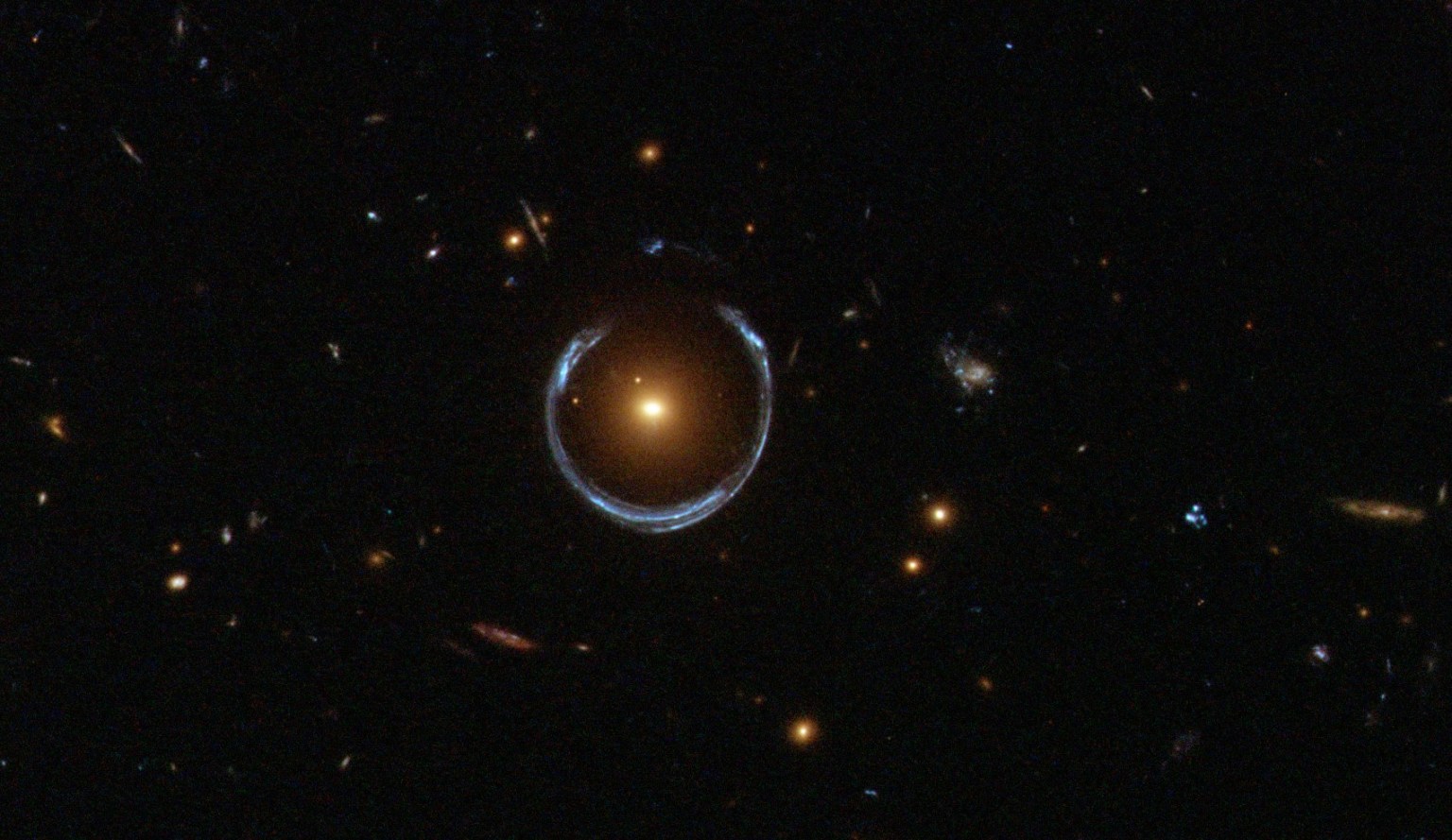
Gravitational lensing: NASA
Gravity and time
Moving closer to a massive object puts you into more heavily curved space.
Physical processes slow down.
Atoms vibrate more slowly, clocks slow down.
This is time-dilation.
An extreme example is at the event horizon of a black hole.
Black hole: NASA’
Here, from the vantage point of a distant observer, time slows almost to a stop.
If you watched someone falling into a black hole, they would seem to move slower and slower.
Eventually, to you, they would remain frozen in time at the edge of the black hole.
A less extreme example is seen in satellites orbiting the Earth.
With slightly weaker gravity, satellite clocks run faster.
The time difference seems tiny, around 50 microseconds per day for GPS satellites.

Earth satellites: NASA
Even so this time difference has an effect.
GPS navigation would drift by several miles every day.
So software adjustments are built-in to keep the GPS accurate.
Astronauts
That brings us nicely to astronauts in space.
They are affected by two opposite time-dilation effects.
Let’s look at astronauts on the International Space Station.
Gravitational time-dilation
The ISS orbits 400 km above the Earth.

ISS/ NASA
Gravity is about 90% of gravity we feel on the ground.
As a result, their clocks tick faster – by about 3 microseconds each day.
But there’s a competing effect at work….
Velocity time-dilation
The ISS travels about 28,000 km/hour to remain in orbit against the pull of gravity.
This high speed makes time go slower – by about 28 microseconds each day.
The result
So speed outweighs gravity for astronauts.
Time passes about 25 microseconds slower each day.
That’s 0.000025 seconds daily.

As a result, an astronaut staying 6 months in orbit would be 5 milliseconds younger than if he or she stayed on Earth.
That’s a whole 0.005 seconds.
So if you want to live a longer life, become an astronaut!
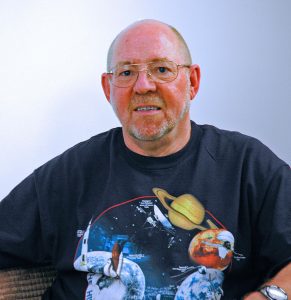
The author: Dennis Ashton, MBE, is a Fellow of the Royal Astronomical Society and a Wonderdome presenter.
In 2024, Dennis received the Special Contribution award from the British Association of Planetaria.
In 2025 he became a Member of the Order of the British Empire for over 50 years work in Astronomy Education.
WonderDome: Leading the Way in Mobile Planetariums
WonderDome offers a fully immersive experience, taking you on a journey through the cosmos. Perfect for all ages and abilities. We now boast a team of 15 presenters, located all over the UK, establishing us as the largest – and best – mobile planetarium organisation in the UK.
Stay Connected for Astronomy News and Events Follow WonderDome mobile planetarium on Twitter / X, Facebook, Instagram and TikTok to stay up to date on the latest news, shows and offers. Or visit our website at wonderdome.co.uk.
WonderDome is part of the Service4Education Group