

On a clear night, the universe opens up to our eyes.
Today we’ll pick some of the top astronomy events of the year.
Welcome to Night Skylights 2026.
Our night sky images are provided by Stellarium.
This super planetarium software is free to download.
Just click Stellarium.
Planets
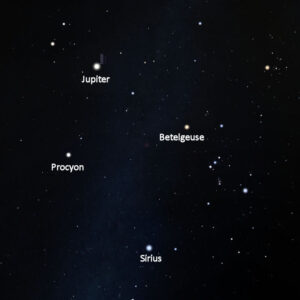
Jupiter continues to be bright in the southern sky through February and into March.
It lies above the Winter Triangle of stars, Sirius, Procyon and Betelgeuse in Orion.
With binoculars you might see the four big moons in line by the planet’s disc.
Jupiter and four large moons: NASA
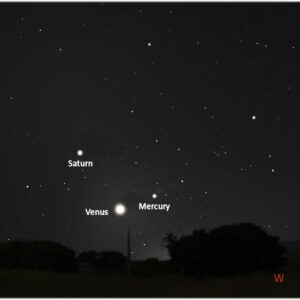
At the end of February, Mercury makes one of its rare appearances.
It’s very low in the west at sunset and is joined by Venus and Saturn.
Bright Venus is to the left, with Saturn, fainter, above.
You need a very low western horizon to see this fleeting planetary trio.
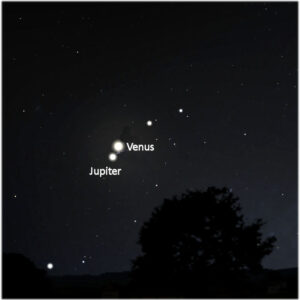
On June 9th, Venus makes a spectacular pairing with setting Jupiter.
The pair can again be seen in the west after sunset.
2026 is not a good year for viewing Mars.
It spends most of time behind the Sun.
But by the year’s end, the red planet will emerge into the late night sky.
It will be back in the evening in early 2027.
Jupiter will also be back in early 2027, whilst Saturn reappears in November.
Meteor Showers
Shooting stars, meteors, always provide excitement in the night sky.
My two favourites are the Perseids in August and the Geminids in December.
These are the most prolific displays of any year.

Perseid meteors, NASA / JPL
Just how many meteors we see depends on two main factors.
They are the weather and the Moon.
We can do nothing about the weather of course.
If it’s cloudy, it’s no meteors.
The Moon is not quite so inhibiting but the brighter the Moon, the fewer shooting stars.
The Moon’s glares obscures all but the brightest meteors.
So what are the prospects for 2026?
The peak night of the Perseids is August 12th / 13th.
Happily that’s coincides with New Moon, so moonlight will not be a problem.
2026 could be a vintage year for this display.
The peak time is 2am on the morning of August 13th.
We can expect around 60 shooting stars an hour at the peak time, one every minute.
There’s a meteor-friendly Moon for the December Geminids too.
The crescent Moon sets by mid-evening, leaving a dark sky for the shooting stars.
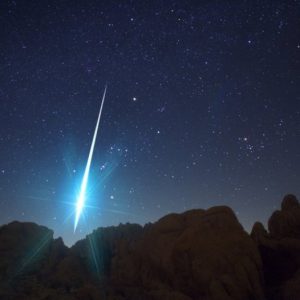
Geminid fireball. NASA
Peak nights are December 13th and 14th.
Meteors will scorch across the sky from twilight onwards.
Comets
Meteors come from dust left trailing in space by comets.
So what are the prospects for seeing a bright comet in 2026?
That’s hard to say.
Comets are like cats. They have tails and are pretty unpredictable.

Comet: NASA
Comets are dirty icebergs that come in from the outer reaches of the Solar System.
As they near the Sun, the ice evaporates, leaving a tail of gas and dust in their wake.
Just how bright the head of the comet and it’s tail will be is always uncertain.

Comet Temple-1 nucleus: NASA/JPL CalTech/UMD
The best bet for 2026 is Comet C/2025 R3 (PanSTARRS).
This comet rounds the Sun on April 20th, at a distance of 76 million km.
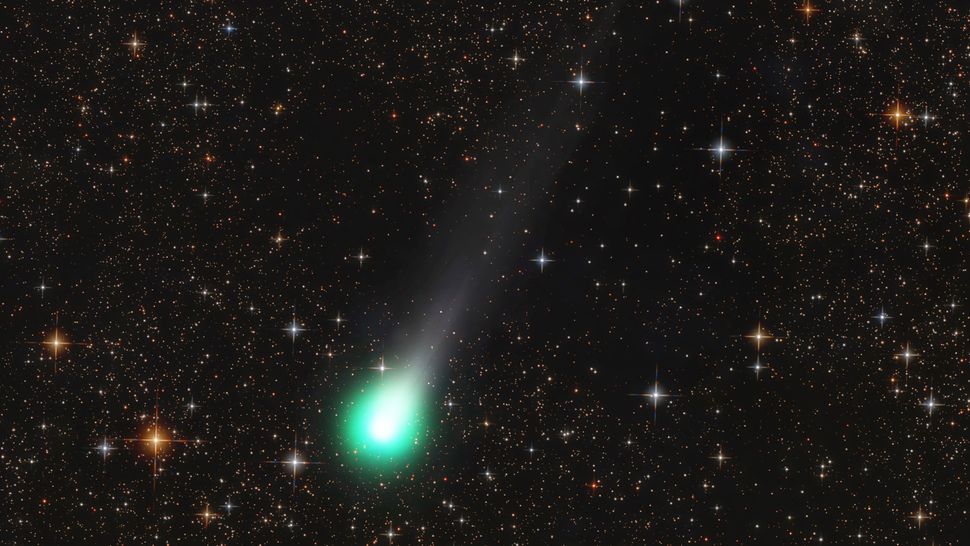
The best times to look for it are before and after it swings around our Sun.
That’s in the morning sky around April 11th and the evening around April 27th
This is when Comet C/2025 R3 will be at its brightest.
But how bright? That’s the key question.
It may need binoculars or a telescope to see it.
Or it might become bright enough to see with the naked eye.
It may appear as bright as the brighter stars.
Time will tell.
And the name, Comet C/2025 R3 (PanSTARRS)?
C/ means a comet. 2025 is the year it was discovered.
R is for the first half of September, 3 for the third comet discovered in that period.
PanSTARRS is the name of the observatory in Hawaii where the comet was discovered.
It stands for Panoramic Survey Telescope and Rapid Response System.
Now there’s a great acronym!

PanSTARRS observatory, Haleakala, Maui, Hawaii.
Total Solar Eclipse
Perhaps the number one highlight of 2026 will be a total Solar Eclipse in Europe.
It will happen on August 12th. Mark that date in your diary.
Eclipse track
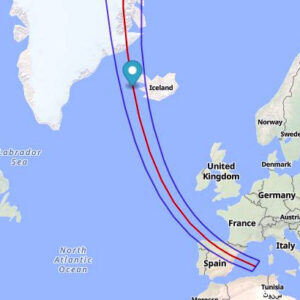
Eclipse track, August 12th: NASA
The eclipse begins at dawn in northern Russia.
It moves through Greenland and on to Iceland.
The eclipse crosses Iceland in mid-afternoon.
Totality lasts only just over a minute.
The eclipse track goes over the Atlantic Ocean to make landfall in northern Spain.
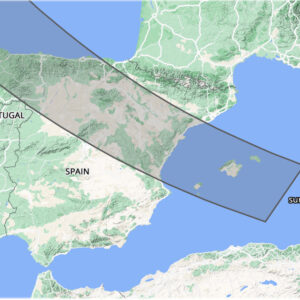
Eclipse track across Spain. NASA
By now, sunset is approaching so the eclipsed Sun is low in the west.
Cities which will see the eclipse include Bilboa, Zaragosa and Valencia.
If you go to Spain for the eclipse, make sure you get a viewpoint with a low western horizon.
What we’ll see in the UK
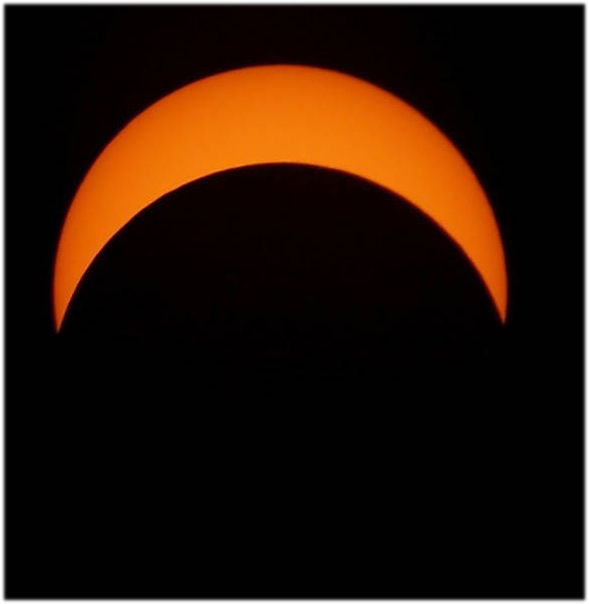
Meanwhile, back in the UK, we’ll see a partial eclipse.
Here the Moon will cover a large part of the Sun.
It’s a considerable partial eclipse.
But it will not go dark.
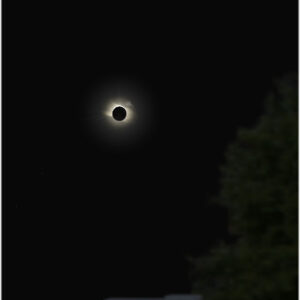
August eclipse from UK: Stellarium.
There’s enough of the Sun’s disc to give almost normal daylight.
The Moon touches the Sun at around 6.15pm.
The eclipse is greatest at 7.13pm, when the Moon covers 90% of the Sun.
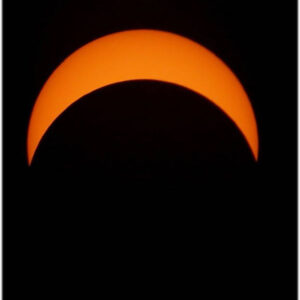
The eclipse ends at 8.06pm.
Again, the Sun will be in the west, it’s late afternoon.
You’ll need to observe the eclipse safely so we’ll give our advice nearer the time.
Skylight Day of the Year
You’ve probably worked out what promises to be the best astronomy day of 2026.
Yes, it’s August 12th.

In late afternoon, there’ll be the big partial eclipse of the Sun.
If you’re lucky enough to be in Spain it will be a magical total eclipse.
Then after dark, the Perseid meteors will scatter across the sky.
An eclipse and shooting stars! Quite a day.
2026 in the Sky
In fact 2026 looks a good year for stargazers.
Planets, shooting stars, an eclipse of the Sun and perhaps a comet.
Clear skies to you all!

The author: Dennis Ashton, MBE, is a Fellow of the Royal Astronomical Society and a Wonderdome presenter.
In 2024, Dennis received the Special Contribution award from the British Association of Planetaria.
In 2025 he became a Member of the Order of the British Empire for over 50 years work in Astronomy Education.
WonderDome: Leading the Way in Mobile Planetariums
WonderDome offers a fully immersive experience, taking you on a journey through the cosmos.
Perfect for all ages and abilities.
We now boast a team of 15 presenters, located all over the UK, establishing us as the largest – and best – mobile planetarium organisation in the UK.
Stay Connected for Astronomy News and Events Follow WonderDome mobile planetarium on Twitter / X, Facebook, Instagram and TikTok to stay up to date on the latest news, shows and offers. Or visit our website at wonderdome.co.uk. WonderDome is part of the Service4Education Group